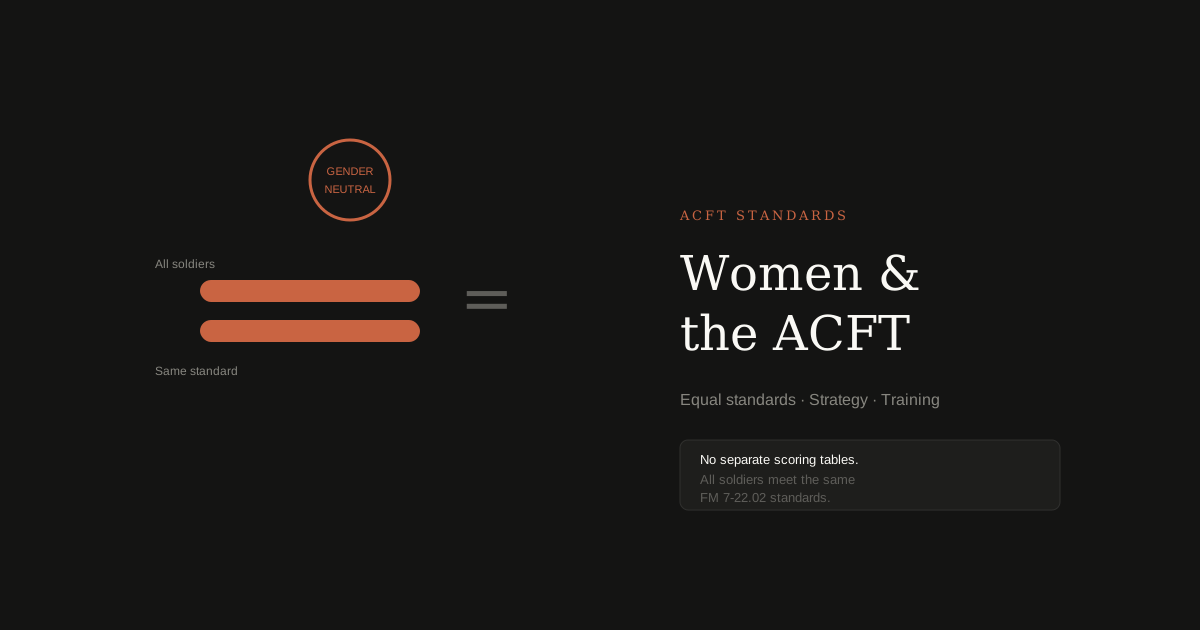
A clear breakdown of ACFT scoring standards for female soldiers, why gender-neutral scoring matters, common performance gaps, and targeted training strategies.
One of the biggest changes the ACFT brought was the move to gender-neutral scoring. Every soldier, regardless of gender or age, is assessed against the same standards. This was a deliberate policy decision rooted in the Army's mission requirements, and it remains in effect today. This guide explains the policy, the history behind it, where female soldiers typically face the steepest performance challenges, and what specific training strategies produce the best results for each event.
Use the ACFT calculator to check exact scores. The same tool and the same tables apply to all soldiers.
Why the Army Moved to Gender-Neutral Scoring
The decision to use gender-neutral standards for the ACFT was not arbitrary. It reflects a policy argument that has been building in the Army since the opening of combat roles to all service members in 2016.
The core argument is straightforward. Combat doesn't adjust its physical demands based on the gender of the soldier performing the task. A soldier of any gender who has to lift a casualty, move under load, or perform sustained physical work in the field faces the same demands. An assessment designed to measure readiness for those tasks should measure performance against those demands, not against a gender-adjusted standard.
The APFT (the predecessor fitness test) used age- and gender-adjusted tables that allowed female soldiers and older male soldiers to meet lower raw performance standards for the same number of points. This created a situation where "passing" the fitness test meant very different things in terms of physical capability depending on the soldier's demographics.
The ACFT was designed from the outset to measure functional fitness. The kind of strength, power, endurance, and agility that field performance actually requires. FM 7-22.02 (the ACFT field manual) reflects this intent explicitly.
The APFT vs. ACFT Standards Comparison
The contrast between the old and new systems is dramatic. Under the APFT, a female soldier in the 27 to 31 age group needed:
- 13 push-ups to score 60 points
- 19:36 for the two-mile run to score 60 points
A male soldier in the same age group needed:
- 35 push-ups to score 60 points
- 16:36 for the two-mile run to score 60 points
Under the ACFT, both soldiers need:
- 20 hand-release push-ups to score 60 points
- 14:54 for the two-mile run to score 60 points
For many female soldiers, especially those from a running-focused fitness background, the push-up minimum under the ACFT is actually lower than the APFT standard for males but comparable to what was required of women. For others, particularly those without strength training backgrounds, the deadlift and power throw represent entirely new physical demands that the APFT didn't test at all.
Brief History: Gender-Adjusted ACFT Standards (and Why They Were Reversed)
In spring 2022, after feedback from the field and a review period, the Army briefly implemented gender-adjusted ACFT scoring tables. Under this temporary system, female soldiers had lower performance requirements for equivalent point scores.
After review, the Army reinstated gender-neutral standards and has maintained them since. The official reasoning emphasized consistency with the combat readiness argument and the intent that was built into the test's design from its inception.
This history matters because there is still confusion among some soldiers about which standards currently apply. To be clear: as of 2026, gender-neutral scoring is the policy. There are no adjustments for gender or age. A female soldier and a male soldier performing the same raw value receive the same number of points.
The Minimum Passing Standards (All Soldiers)
The minimum passing scores for all soldiers:
- MDL: 205 lbs
- SPT: 7.3 meters
- HRP: 20 reps
- SDC: 2:12
- PLK: 2:54
- 2MR: 14:54
These are the same standards shown in the ACFT passing score guide. No adjustments.
Where Female Soldiers Tend to Face Bigger Performance Gaps
Research on ACFT performance by gender, including Army-commissioned studies and post-implementation data, shows consistent patterns across events.
Upper body and power events (MDL, SPT, HRP): The largest average performance gaps between male and female soldiers show up in the deadlift and power throw, which depend heavily on absolute strength and explosive power output. Average muscle mass, which is higher in males on average, contributes directly to maximal force production in these events.
But that average gap doesn't predict any individual soldier's performance. Female soldiers with strength training backgrounds routinely outperform male soldiers without them. The MDL is a highly trainable movement, and the strength gap narrows significantly with focused programming.
Core and aerobic events (PLK, 2MR): The average performance gap is measurably smaller for the plank and two-mile run. Female soldiers often perform comparably or within a narrow margin of male peers on these events, particularly when both groups have similar training histories. The 2MR, specifically, shows the smallest average gender gap of the six events.
SDC: The sprint-drag-carry shows a moderate gap because it combines upper-body strength (drag), aerobic capacity, speed, and grip endurance. It sits between the pure strength events and the aerobic events in terms of typical performance differences.
The key takeaway: For female soldiers starting from a general fitness baseline (regular running and bodyweight work) without dedicated strength training experience, the deadlift and power throw typically require the most new training investment. Plank and running are usually the fastest paths to solid passing scores.
Event-by-Event Training Strategies for Female Soldiers
Deadlift (MDL): Building to 205 lbs
Most female soldiers who haven't trained the hex bar deadlift before find 205 lbs achievable within 8 to 16 weeks of dedicated training. This is not a guarantee (individual variation is significant) but it's a realistic target for healthy soldiers who start a structured progressive loading program.
Why this works: The deadlift is fundamentally a hip hinge. A movement pattern that relies heavily on the glutes and hamstrings, which are typically strong muscle groups in female athletes. The hex bar grip positions also reduce the technical demands compared to a conventional barbell deadlift, making it more accessible to new lifters.
Common issue for female soldiers: Defaulting to a squat pattern rather than a hip hinge. When the hips are too far forward at the start, the lift becomes a leg press from a disadvantaged position and the posterior chain (glutes, hamstrings) contributes less force. The fix is to learn to push the hips back before descending, feeling the stretch in the hamstrings as the bar-starting position loads up.
Specific approach:
- Start with the hex bar at 95 to 115 lbs and add 5 lbs per session (or 10 lbs every other session)
- Train the deadlift twice per week
- Prioritize the hip hinge pattern above all else. Technique matters more than load early in training.
- Add farmer carries and Romanian deadlifts as accessory work to build grip strength and hip hinge reinforcement
For full guidance, see the deadlift tips guide.
Standing Power Throw (SPT): Reaching 7.3 Meters
The SPT minimum of 7.3 meters requires genuine explosive hip power, not just arm strength. Female athletes without athletic throwing backgrounds may initially throw 4.5 to 5.5 meters, with 7.3 m reachable within 6 to 10 weeks of targeted technique and power training.
Why technique matters more than raw strength here: The SPT is a chain of power transfer. Ground to legs to hips to torso to arms to ball. Soldiers who throw primarily with their arms leave 1.5 to 2.5 meters of distance on the ground. Fixing the hip drive component is often worth more than months of strength training.
Specific approach:
- Practice kettlebell swings extensively. The hip hinge to explosive hip extension pattern is almost identical to the SPT drive phase
- Throw at maximum effort 3 to 4 times per week. The throwing pattern improves rapidly with repetition
- Video your throws from the side to check whether your hips are actually driving or your arms are doing the work
- Practice broad jumps and box jumps to develop explosive power in the legs and hips
See the standing power throw guide for full technique breakdown.
Hand-Release Push-Ups (HRP): Building to 20 Reps
Twenty hand-release push-ups in 2 minutes requires upper body muscular endurance. The hand-release requirement is often the biggest technical adjustment for soldiers used to standard push-ups. The full chest-and-thigh contact requirement changes the depth and eliminates the elastic rebound that makes standard push-ups easier.
Common challenge for female soldiers: Many female soldiers without strength training backgrounds find that standard push-ups are hard to perform with full range of motion. The first training priority is the movement itself, not the hand-release specifically.
Specific approach:
- If you can't yet do 10 standard push-ups, begin with incline push-ups (hands elevated on a bench or box) and gradually lower the incline as you get stronger
- Practice the hand-release technique specifically from the first day. The rhythm changes significantly and has to be learned.
- Build daily volume: 100 total push-ups per day spread across multiple sets develops the muscular endurance needed for test performance
- Add ring rows or bodyweight rows to address the pulling/retracting muscles that support shoulder health and push-up longevity
For full technique guidance, see the HRP guide.
Sprint-Drag-Carry (SDC): Beating 2:12
The SDC combines strength, grip endurance, speed, and agility in roughly 90 seconds of full-effort work. The 90-lb sled drag is often the most challenging element for female soldiers who haven't trained specifically for backward sled work.
Key insight: The drag is not an arm exercise. It's a leg-drive exercise. Soldiers who stand upright and pull with their arms slow dramatically by the midpoint. The correct technique is hips low, legs driving, arms maintaining tension on the strap. Similar to the pushing position of a truck push. Correcting this mechanics issue alone can improve SDC time by 8 to 15 seconds.
Specific approach:
- Grip training: Dead hangs from a pull-up bar, farmer carries, and barbell holds are essential. Grip failure during the drag or carry phase is a major time-loser.
- Practice the full course multiple times in training. SDC performance is heavily dependent on course familiarity and transition speed
- Develop lateral agility with dedicated shuffle drills. The lateral phase should not be a rest phase. It should be an aggressive shuffle.
Check the sprint-drag-carry calculator for scoring reference.
Plank (PLK): Holding 2:54
The plank is typically the most accessible ACFT event for female soldiers. The 2:54 minimum is achievable for virtually all healthy soldiers with consistent training, and female soldiers often approach or exceed this standard faster than other events because the plank relies more on core endurance relative to body mass than on absolute strength.
Key technique insight: Most untrained soldiers plank with only their core engaged, leaving enormous time on the table. Full-body tension (contracting glutes, quads, and even fists at the same time) distributes the work and can add 30 to 60 seconds to hold time without any fitness improvement.
Specific approach:
- Practice the plank daily, even for short sessions
- Apply full-body tension technique from the first session and measure the difference
- Add isometric core exercises: hollow body holds, dead bugs, and bird dogs to build the core endurance that supports longer plank times
- Progress by adding 15 seconds per week to your maximum hold time
See the plank tips guide for the complete program.
Two-Mile Run (2MR): Running Under 14:54
The 14:54 minimum requires a 7:27/mile pace. A meaningful standard that demands real aerobic fitness. Female soldiers who have been doing aerobic PT consistently often find the 2MR the most accessible ACFT event relative to the others.
Key insight: Many soldiers spend all their running training at easy-to-moderate paces and never improve their speed. If you currently run consistently but are plateauing around 15:30 to 16:00, the missing element is usually quality work. Intervals and tempo runs at or above goal pace.
Specific approach:
- Add one quality session per week: 6 to 8 x 400m intervals at faster-than-goal pace, or a 20-minute tempo run at goal pace
- Practice pacing. 7:27/mile should feel controlled in mile 1 and challenging in mile 2. Going out too fast in mile 1 causes disproportionate slowdowns in mile 2.
- Maintain strength training while building running volume. Lower body strength improves running economy and reduces injury risk
For the full training guide, see the two-mile run guide.
A Practical Weekly Training Structure for Female Soldiers Building Toward a Full ACFT Pass
The following is a general weekly structure for a female soldier with a running background but limited strength training experience, targeting 6 to 10 weeks out from a record ACFT:
| Day | Training Focus |
|---|---|
| Monday | Strength: Deadlift 4x5, hip thrusts 3x10, farmer carries |
| Tuesday | Conditioning: SDC practice (3 full sets) + HRP volume (4xmax) |
| Wednesday | Running: Easy 25 to 30 min + plank practice |
| Thursday | Strength: Deadlift variation, push-up volume, kettlebell swings (SPT prep) |
| Friday | Running: Intervals (6x400m) or tempo (20 min) |
| Saturday | Full event simulation or active recovery |
| Sunday | Rest |
This structure prioritizes the strength events (MDL, SPT, HRP) while maintaining running fitness and including specific SDC and plank work. Adjust based on your individual event scores. Whatever is closest to the 60-point minimum should get extra sessions.
Priority Order for Female Soldiers Starting From a General Fitness Baseline
If you're a female soldier starting from a general fitness base (regular running, some bodyweight training) but without dedicated strength training experience, here's the recommended priority order:
- Deadlift first. Requires the most lead time to build the strength base. Start strength training immediately.
- Power throw second. Hip explosive work overlaps significantly with deadlift training (kettlebell swings, hip thrusts, broad jumps). You can train both at the same time.
- Plank. Highly responsive to training, but needs consistent daily practice rather than occasional sessions
- HRP. Progressive volume with technique refinement. Daily practice is the fastest route to 20+ reps.
- SDC. Practice the full course. Grip and conditioning are key differentiators.
- 2MR. Add quality running sessions (intervals, tempo) to existing aerobic base. Running-fit soldiers usually need speed work, not more mileage.
The 12-Week ACFT Training Plan covers all six events with specific programming that can be adapted for this priority order.
Mental Preparation and Managing the Standard
The gender-neutral standard creates a specific psychological challenge for some female soldiers. They may feel the standard is unfair, especially early in training when the gap between their current performance and the minimum feels large.
The most productive reframe: focus entirely on what you control. The standard is fixed. Your performance is trainable. Most female soldiers who approach the ACFT with a structured training plan and 12 to 16 weeks of preparation pass all six events. The ones who don't are typically those who wait too long to start focused training, or who train the events they already do well while avoiding the ones where they're weak.
Identify your weakest event. Train it first and most. Use the ACFT calculator to track your progress event by event. Every 5-point improvement in your weakest event is a direct reduction in your career risk.
Frequently Asked Questions
Are the minimum passing scores actually the same for men and women?
Yes. The same tables used for male soldiers are used for female soldiers. This has been the policy since gender-neutral scoring was reinstated in 2022.
Were there ever gender-adjusted ACFT standards?
Yes, briefly. In spring 2022, the Army temporarily implemented gender-adjusted scoring while reviewing feedback. After that review, gender-neutral standards were reinstated and remain in effect today.
What events have the largest average male-female performance gap on the ACFT?
Research and post-implementation data consistently show the MDL and SPT have the largest average performance differences. The PLK and 2MR tend to show the smallest average differences.
Is the 205-lb deadlift realistic for all female soldiers?
For healthy soldiers without injury limitations and with appropriate training time, yes. The hex bar deadlift is a highly learnable movement, and 205 lbs is within range for most adult women with 8 to 16 weeks of dedicated progressive loading. It may take longer than for a male soldier starting from a similar baseline, but it's achievable with consistent, structured training.
Can female soldiers score 100 on all events?
Yes, and some do. The 100-point standards require exceptional performance across all six events, but they are not biologically impossible for female soldiers. The most common limiting events for maximum scoring are the MDL (340 lbs), SPT (12.5 m), and HRP (60 reps in 2 minutes).
What if I'm consistently near the minimum on all events. Where should I focus?
Focus on whichever event is closest to the 60-point minimum first. A margin of 5 to 10 points on your weakest event is a career protection priority. Use the ACFT calculator to identify your exact score per event, then target the one with the least cushion above 60.
Free Calculator
Ready to check your score?
Use the free ACFT calculator to instantly score all 6 events based on official FM 7-22.02 standards.
Open ACFT Calculator →Related Articles
ACFT Scoring Guide: How the Army Fitness Test is Scored
Complete breakdown of all 6 ACFT events: scoring tables, pass/fail criteria, linear interpolation, a…
12-Week ACFT Training Plan to Max Your Score
Week-by-week ACFT training plan with periodization, event-specific programming, assessment week, nut…

ACFT Passing Score: Minimums, Requirements & Retest Policy
Everything you need to know about ACFT minimum scores, per-event passing thresholds, what a perfect …