
ACFT hand-release push-ups explained: correct technique, common form faults that cause no-counts, and programming to hit 40+ reps on test day.
The hand-release push-up is the ACFT's upper-body endurance event. Soldiers who've trained standard push-ups for years might feel confident, but the HRP has specific requirements that change the movement mechanics enough to significantly impact your score. Understanding exactly what counts, and what gets no-counted by the grader, is the starting point. Then comes the training.
This guide covers the full spectrum: technique, no-count prevention, pacing strategy, and an 8-week progression program for soldiers from 15 reps to 50+ reps.
Use the push-ups calculator to check your score, and the ACFT calculator to see your full picture.
What the Hand-Release Push-Up Actually Is
The hand-release push-up was selected for the ACFT because it eliminates two common cheats in standard push-ups: partial range of motion and elastic rebound. In a standard push-up, a soldier can lower to 90 degrees of elbow bend and bounce slightly at the bottom to use the stretch reflex. Neither is possible in the HRP.
By requiring chest AND thigh contact with the ground and a complete hand release before pressing up, the ACFT forces each repetition to start from a dead-stop with full range of motion. This makes every rep genuinely harder, and it means your training pace for standard push-ups does not directly predict your HRP performance.
What Counts as a Valid HRP Repetition
A valid hand-release push-up requires four discrete elements, each of which a grader can check:
- Start position: Arms fully extended, body in a rigid plank position (straight line from head to heels)
- Descent: Lower your body until your chest AND thighs contact the ground simultaneously
- Release: Fully lift both hands off the ground at the bottom
- Press: Return to full arm extension at the top
Missing any single element results in a no-count for that rep. A no-count doesn't stop the clock. It just means that rep doesn't count toward your total. The grader will typically call "no count" or make a visible signal. Do not argue mid-event. Adjust your form and continue.
What Gets No-Counted
Chest down, thighs not touching: If your chest hits first and you raise your hands before your thighs reach the ground, that's a no-count. This is the most commonly missed requirement. Many soldiers are accustomed to touching only their chest in standard push-ups. The simultaneous thigh contact requires a fuller descent.
Incomplete hand release: Lifting your fingers while keeping your palms partially in contact, or only lifting one hand, is a no-count. Both hands must clearly leave the surface. The lift doesn't need to be high (an inch of clearance is fine) but it must be visible.
Elbows not fully locked at the top: Partial lockout at the top position is a no-count. Arms must be fully extended (elbows straight) at the start and end of each rep. If you develop shoulder or elbow fatigue that prevents full lockout, you'll start accumulating no-counts.
Breaking the plank position: Sagging hips at any point in the movement, whether at the top position, during descent, or when releasing your hands, can result in a no-count. A grader who sees your hips sagging to the floor before your thighs have been counted may also call a no-count on the intent to keep reps honest.
Starting a rep before the hands are down: You must be in a full plank with arms extended before beginning the next descent. Starting the next rep while still completing the previous rep's press is a no-count and also risks injury.
ACFT HRP Scoring: What Each Rep Range Is Worth
The HRP has a front-loaded scoring table. Each rep from 10 to 20 is worth roughly 8 points. Above 30, each additional rep is worth only 1 point. This creates clear priorities.
| Reps | Points |
|---|---|
| 10 | 0 |
| 15 | 40 |
| 20 | 60 ✓ (minimum pass) |
| 21 | 62 |
| 25 | 70 |
| 28 | 74 |
| 30 | 76 |
| 34 | 80 |
| 40 | 86 |
| 45 | 90 |
| 50 | 95 |
| 60 | 100 |
Practical implications:
- Every rep from 10 to 20 is worth about 4 points. Getting from 15 to 20 reps is worth 20 points, a huge scoring gain.
- Going from 20 to 30 reps (10 reps) is worth 16 points.
- Going from 30 to 40 reps (10 more reps) is worth only 10 points.
- Going from 40 to 60 reps (20 more reps) is worth only 14 points.
The priority is clear: first reach 20, then push to 25 or 30 for a comfortable margin. Beyond 30, additional reps are worth fewer points per rep of training investment.
Full Technique Guide for Efficient HRPs
The HRP is a technical event, not just a fitness one. Soldiers who understand efficient movement patterns will get more valid reps per unit of energy than those who just go hard.
Setup and Starting Position
Place your hands slightly wider than shoulder-width. Fingers can point directly forward or very slightly outward. Experiment with what feels most natural for your shoulder structure.
Form a straight line from head to heels. Lock out your elbows fully. This is a true plank position, not a modified one. Your hips should not be high (pike) or low (sag).
Hand placement width matters: Too narrow (hands under your shoulders) is harder on the triceps and more demanding per rep. Too wide stresses the shoulder joint. Standard push-up width, just outside the shoulders, is optimal for most soldiers.
The Descent: Controlled but Purposeful
Lower your body as a rigid unit. Do not let your hips drop first or your chest lead independently.
Contact requirement: Both your chest and thighs must contact the ground simultaneously. In practice, this means your hips need to descend enough that your thighs are in contact with the ground at the same time your chest hits. For some soldiers this is natural. For others, it requires a conscious adjustment to lower the hips more than they're accustomed to.
Do not slam yourself into the ground. A controlled descent (not slow, but not a crash) is faster for recovery and reduces the jarring effect on your shoulders and wrists. Crashing into the ground at high speed creates micro-fatigue that accumulates over the 2-minute window.
The Release: Quick and Clean
Once both chest and thighs are in contact with the ground, immediately lift both hands. The lift should be:
- Simultaneous (both hands at the same time)
- Clearly off the surface (visible separation, an inch is fine)
- Quick (don't pause at the bottom longer than necessary)
Your legs and core must maintain engagement when your hands lift. Some soldiers let their hips sag when their hands come up. That creates a floppy body position that's harder to press out of and may draw a no-count.
Do not lift your hands high. That wastes energy and time. A small, clean, visible lift is exactly what you need.
The Press: Drive to Full Lockout
Drive through your palms and press to full arm extension. The lockout is mandatory. Do not start the next descent until your elbows are fully extended.
Maintain plank position throughout the press. Hips should not sag during the press (a sign of weakening core/glute engagement) or pike up (a sign of fatigue avoidance).
Pacing: The Most Important Variable
Most HRP failures are pacing failures. A common mistake: going out at maximum speed, accumulating 12 to 15 reps in the first 45 seconds, and then falling apart as no-counts accumulate, arms shake, and rest comes in the down position.
Representative rep time analysis:
- 1 rep every 2 seconds = 60 reps possible (theoretical maximum)
- 1 rep every 3 seconds = 40 reps possible
- 1 rep every 4 seconds = 30 reps possible
- 1 rep every 5 seconds = 24 reps possible
For most soldiers targeting 25 to 35 reps, a rep every 3.5 to 4 seconds in the first 90 seconds, then a push in the final 30 seconds, is optimal.
Landmark pacing guide for a 30-rep target:
- 30-second mark: 8 to 9 reps (1 rep every ~3.5 seconds)
- 60-second mark: 16 to 18 reps (maintaining pace)
- 90-second mark: 23 to 25 reps (still controlled)
- 90 to 120 seconds: push remaining reps as fast as form allows
Authorized rest positions: You can rest in the up position (elbows fully extended, holding the plank) or the down position (lying flat on the ground). You can't rest on your knees, on bent arms, or in any mid-range position. If you need 5 to 10 seconds to recover, take it in an authorized position.
8-Week HRP Training Program
This program assumes you're training HRPs specifically, on top of your regular PT. Frequency: 3 days per week of dedicated HRP work with at least 1 day of rest between sessions.
Week 1 to 2: Establish Baseline and Build Volume
Session structure: 5 working sets with 90-second rest between sets.
- If max reps < 10: 5 × 5 incline push-ups (hands elevated), then 5 × max standard push-ups
- If max reps 10 to 15: 5 × max HRPs to form failure (track your numbers)
- If max reps 15 to 25: 5 × 70% of max HRPs, strict form, 90-second rest
- If max reps 25 to 35: 4 × 80% of max, 90-second rest + 1 × max effort to end
Daily accessory (any day, even non-HRP days):
- "Grease the groove": every 2 to 3 hours, do 5 to 8 HRPs. Not to failure. Fresh reps only. This daily exposure accelerates neural adaptation and builds volume without excessive fatigue.
Week 3 to 4: Increase Volume and Add Specificity
Session structure: 6 working sets.
- Paused push-ups: 3 × 8 to 10 (pause 1 full second at the bottom position, which simulates the hand-release stop and builds strength out of the bottom)
- HRP sets: 3 × max reps with 90-second rest
- Track weekly max set and aim for a 2 to 3 rep improvement each week
Supplementary work (add 2 days per week):
- Tricep dips: 3 × 12 to 15 (lockout strength)
- Diamond push-ups: 3 × 8 to 10 (tricep and shoulder endurance)
- Band pull-aparts: 3 × 15 (rear deltoid and rotator cuff health, which is key for shoulder longevity in high-volume push-up training)
Week 5 to 6: Density Training and Endurance Development
Session 1 (density method):
- Set a 10-minute timer
- Every 45 seconds: 5 HRPs
- Total: approximately 65 reps in 10 minutes
- This builds the specific muscular endurance for sustained HRP performance in the 2-minute window
Session 2 (max effort with full rest):
- 3 × max HRPs with 3-minute rest between sets
- The extended rest allows near-maximal effort on each set
- Track your best set. That's your performance ceiling this week.
Session 3 (moderate volume):
- 5 × 70% of current max HRPs with 90-second rest
- Add 1 set of weighted push-ups (vest or plate on back): 3 × 10
Week 7 to 8: Peak and Taper
Week 7:
- Increase max-effort sets: 2 × max HRPs with 4-minute rest
- Continue density work 1×/week
- Add 1 full 2-minute simulated test: do HRPs for the full 2 minutes and count your total. That's your benchmark.
Week 8 (taper):
- Reduce volume by 30 to 40% but maintain intensity
- 2 sessions only (not 3)
- 1 session: 3 × 80% of max with 90-second rest
- 1 session: 1 max-effort set, then stop
- 3 to 4 days before the test: no HRP training. Let muscles recover fully.
Mobility and Shoulder Health: Preventing Breakdown During Training
High-volume HRP training without mobility work leads to two common problems: wrist pain (from the ground contact and weight-bearing at the extended wrist) and shoulder impingement (from repetitive pressing without pulling work).
Wrist care:
- Wrist circles: 30 seconds per direction before every session
- Wrist flexor stretch: 30 seconds per side
- Consider doing some push-up volume on fists if wrist pain develops (reduces wrist extension angle)
Shoulder care:
- Band pull-aparts: 3 × 15 every pushing day
- Face pulls (or any pulling/external rotation exercise): 3 × 15 two days per week
- Pec doorway stretch: 30 seconds per side
General rule: For every pushing set you do, do a pulling set. If you do 6 sets of HRPs, do 6 sets of rows, band pull-aparts, or pull-ups. This maintains shoulder balance and prevents the chronic anterior shoulder dominance that leads to impingement.
Test-Day Execution
Before the HRP
The HRP is the third ACFT event, coming after the deadlift and standing power throw. Your grip, back, and shoulders have already done meaningful work. This matters for pacing. Your fatigue state at the start of the HRP isn't the same as it would be at the beginning of a standalone push-up test.
In training, practice HRPs after performing the first two events (or after a heavy strength workout) to simulate the real test-day fatigue state. Soldiers who only practice HRPs fresh routinely perform worse on test day than expected.
Pre-HRP routine: In the transition time between SPT and HRP, shake out your arms, roll your shoulders, and take several slow deep breaths. You want to arrive at the HRP starting position with arms not pre-fatigued from the SPT, mentally reset, and ready to go.
Hand Placement Strategy
Find your optimal hand width in training (the position that lets you lock out fully, lower to simultaneous chest-thigh contact, and hold a solid plank) and memorize it. On test day, set your hands immediately at that position.
Some soldiers find chalk or a rubber surface helps grip security. If your test site permits chalk, and if sweaty palms are an issue for you, it's worth using.
Breathing
Breathe on every rep. Inhale on the descent, exhale on the press. Holding your breath increases intra-abdominal pressure temporarily but isn't sustainable for 2 minutes and leads to much faster fatigue. Consistent breathing rhythm also serves as a natural pacing cue.
For more training resources, see the 12-Week ACFT Training Plan for a fully integrated program covering all six events. See the ACFT passing score guide for a clear breakdown of what each score means for your career.
Frequently Asked Questions
How is the hand-release push-up different from a standard push-up?
The key difference is the mandatory hand lift at the bottom of every rep, combined with a deeper descent requirement. In standard push-ups, you only need to lower to roughly 90 degrees of elbow bend. In HRPs, you must lower until chest AND thighs contact the ground simultaneously, then fully release both hands before pressing up. The mandatory full descent and hand release eliminate the bounce and partial range-of-motion shortcuts.
Can I rest during the HRP?
Yes, in the up position (elbows fully locked, body in plank) or the down position (lying flat on the ground). You can't rest in a mid-range position, on bent arms, or on your knees.
What if my chest is on the ground but my thighs haven't touched yet?
That rep will be no-counted. You must have both chest and thighs in contact with the ground simultaneously before releasing your hands. This simultaneous requirement is the most commonly missed technical element.
Does the hand release have to be high?
No. The grader needs to see both hands clearly leave the surface. A minimal, clean lift (an inch or two) is enough. Don't waste energy or time lifting your hands high above the ground.
Is there a minimum pace requirement?
No. You can take any amount of time for each rep. The only constraint is the 2-minute total window. Resting between reps in authorized positions is permitted.
What's the fastest realistic way to add 10 reps to my HRP max?
The fastest route depends on your current level. If you're under 15 reps, daily volume (grease the groove) combined with strength work (incline push-ups, pause push-ups) produces rapid gains. If you're at 20 to 30 reps, density training (many sets of moderate reps with short rest) and one max-effort set per week produces the best results. If you're at 30+, the gains come more slowly. Focus on weighted push-ups for strength and near-max density sessions.
Free Calculator
Ready to check your score?
Use the free ACFT calculator to instantly score all 6 events based on official FM 7-22.02 standards.
Open ACFT Calculator →Related Articles
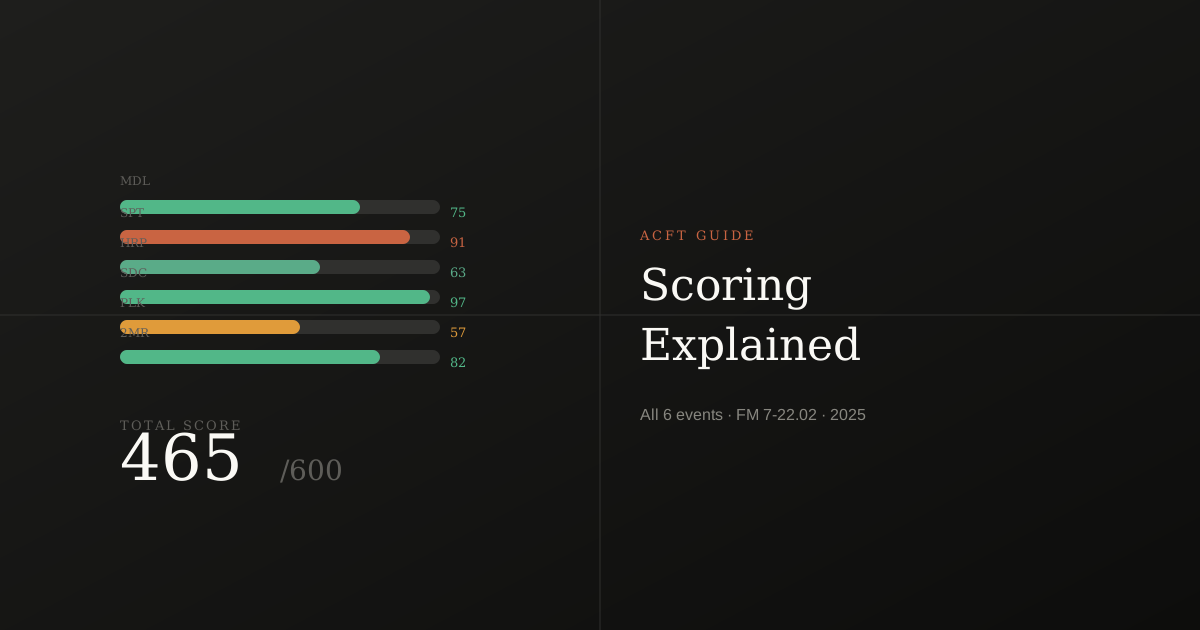
ACFT Scoring Guide: How the Army Fitness Test is Scored
Complete breakdown of all 6 ACFT events: scoring tables, pass/fail criteria, linear interpolation, a…
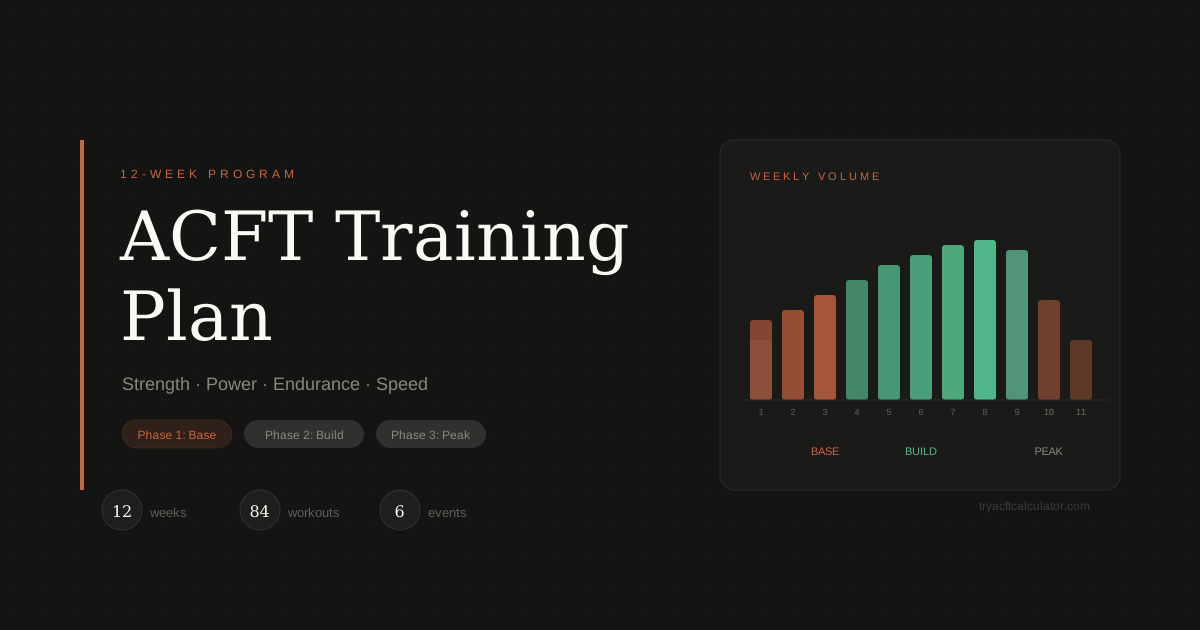
12-Week ACFT Training Plan to Max Your Score
Week-by-week ACFT training plan with periodization, event-specific programming, assessment week, nut…
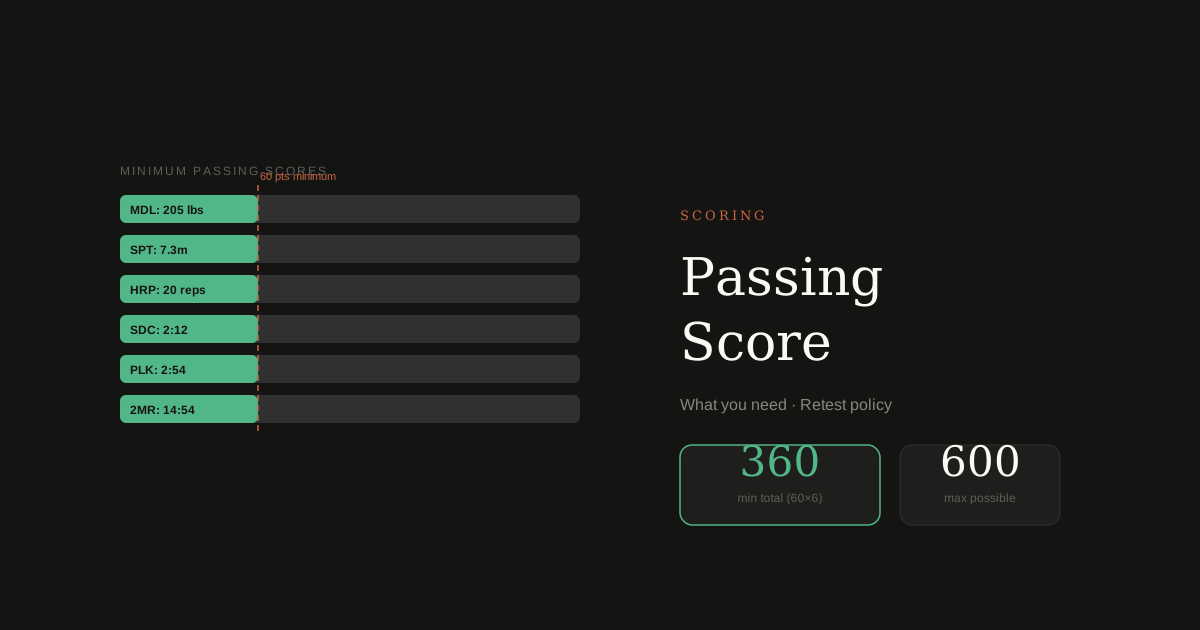
ACFT Passing Score: Minimums, Requirements & Retest Policy
Everything you need to know about ACFT minimum scores, per-event passing thresholds, what a perfect …