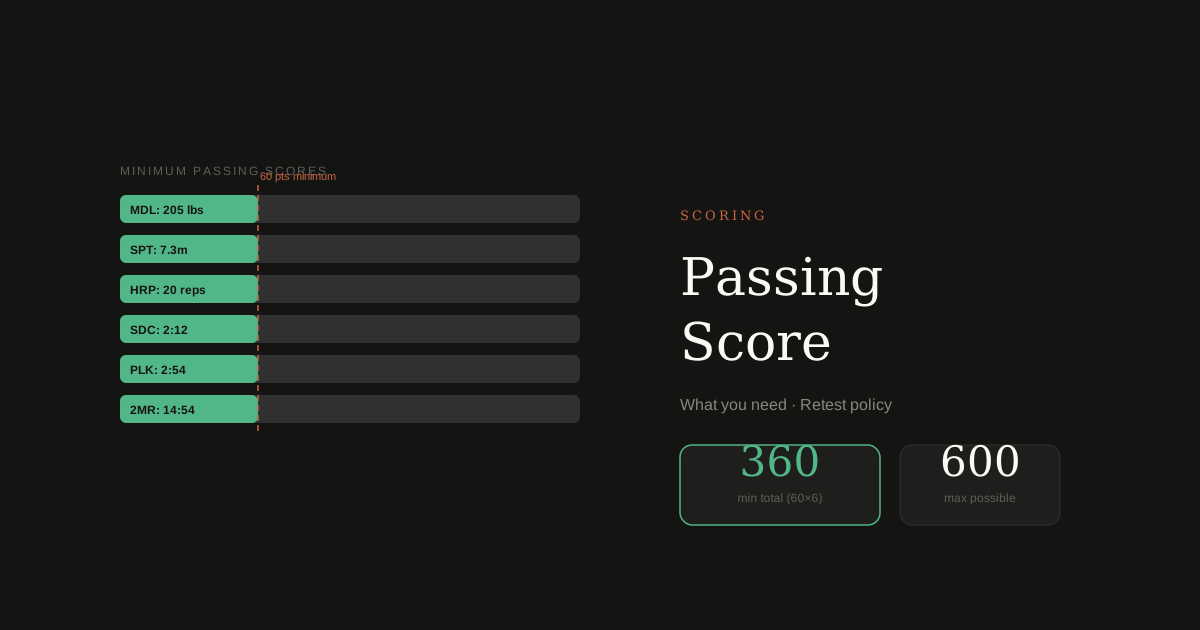
Everything you need to know about ACFT minimum scores, per-event passing thresholds, what a perfect score looks like, and what happens if you fail.
One of the most common questions soldiers have about the ACFT is simple: what score do I need to pass? The answer is slightly different from what you might expect from the old APFT, and getting it wrong can cost you your career progression. This guide covers every aspect of ACFT passing standards. From the exact raw values that earn 60 points on each event, to what happens when you fail, to the score tiers that actually matter for promotions and competitive assignments.
Use the ACFT calculator to find out exactly where you stand right now.
The Core Passing Standard: 60 Points Per Event
The ACFT passing standard is 60 points on each of the 6 events. That's it. There's no minimum total score, no averaging across events, and no partial credit for being close.
If you score 100 on five events and 59 on the sixth, you fail the test.
This per-event minimum fundamentally changes how you should approach training. Under the APFT, a strong performance in push-ups could offset a weak run. That trade-off no longer exists. Neglecting any single event is a direct career threat, regardless of how elite your performance is in the other five.
This structure also means that a soldier who scores 60 on all six events (360 total) and a soldier who scores 100 on all six events (600 total) are both "passing" in terms of Army administrative requirements. The distinction matters for competitive purposes, which we'll cover below.
Per-Event Minimum Passing Values: What 60 Points Actually Requires
Understanding the minimum is one thing. Understanding what physical performance that number represents is another. Here's the full breakdown of what you must do to earn 60 points on each event:
Deadlift (MDL): 205 lbs
The hex bar deadlift minimum is 205 pounds for three consecutive repetitions. This is a meaningful strength standard, roughly 100% to 125% of bodyweight for most soldiers, but it's very achievable with targeted training. The deadlift is one of the most trainable lifts in existence, and soldiers who start structured programming from a low baseline often add 50 to 80 lbs to their 3RM within 12 to 16 weeks.
At 205 lbs, you earn 60 points. At 210 lbs, you earn 62. At 340 lbs, you earn 100. The scoring density changes significantly past 300 lbs, where each additional 5 lbs earns only 1 additional point.
See the deadlift calculator to find your exact score.
Standing Power Throw (SPT): 7.3 meters
You must throw the 10-lb medicine ball at least 7.3 meters on your best of two attempts. To visualize this distance: a standard car is about 4.5 meters long. You need to throw nearly two car lengths.
The SPT is the most technique-dependent event. Soldiers with similar explosive power can differ by 1 to 2 meters based on technique alone. If you're near the 7.3m threshold, a technique fix may be faster than a fitness improvement. Check the power throw calculator and read the standing power throw guide for mechanics details.
Hand-Release Push-Ups (HRP): 20 reps
You must complete 20 valid hand-release push-up repetitions within 2 minutes. Each rep requires lowering until both chest and thighs contact the ground at the same time, fully releasing both hands from the surface, then pressing back to full arm extension.
Twenty reps in 2 minutes works out to roughly one rep every 6 seconds. A pace most soldiers find manageable if they understand the correct technique. The challenge is the full chest-and-thigh contact requirement, which eliminates the partial range-of-motion push-up that many soldiers default to. See the push-ups calculator for scoring reference.
Sprint-Drag-Carry (SDC): 2:12
You must complete all five phases of the SDC course in 2 minutes and 12 seconds or faster. The course involves a 25m sprint, 90-lb sled drag, lateral shuffle, 80-lb kettlebell carry (two 40-lb kettlebells), and a final sprint. All in a 25-meter lane.
The 2:12 minimum is not the finish line for training purposes. It's a time that requires genuine conditioning and technique work, and it leaves almost no margin for error in transitions. Check your time with the SDC calculator.
Plank (PLK): 2:54
You must hold the standard plank position for 2 minutes and 54 seconds. The plank position requires forearms on the ground, body in a straight line from head to heels, and no sagging or piking of the hips.
Nearly three minutes is a genuine test of core endurance. But it's also one of the most trainable standards on the ACFT. Most soldiers who've never trained the plank specifically are surprised how quickly their hold time improves with consistent practice. The full-body tension technique (squeezing glutes, quads, and fists at the same time) alone adds 20 to 45 seconds for most untrained soldiers. See the plank calculator.
Two-Mile Run (2MR): 14:54
You must run two miles in 14 minutes and 54 seconds or faster. A per-mile pace of about 7:27. This pace requires genuine aerobic fitness and is meaningfully faster than a jog.
The 2MR is the most familiar ACFT event for most soldiers (it's been in Army testing since the APFT era), but that familiarity can breed complacency. Many soldiers maintain just enough running fitness to pass without training specifically, then find themselves running 15:30 or 16:00 on test day after a few months of reduced training. Use the two-mile run calculator to track your score precisely.
The Full Per-Event Minimum Table
| Event | Code | Minimum Passing |
|---|---|---|
| 3 Rep Max Deadlift | MDL | 205 lbs |
| Standing Power Throw | SPT | 7.3 meters |
| Hand-Release Push-Ups | HRP | 20 reps |
| Sprint-Drag-Carry | SDC | 2:12 (2 min 12 sec) |
| Plank | PLK | 2:54 (2 min 54 sec) |
| Two-Mile Run | 2MR | 14:54 (14 min 54 sec) |
Check your individual event scores instantly with the dedicated calculators:
- Deadlift calculator
- Power throw calculator
- Push-up calculator
- SDC calculator
- Plank calculator
- 2MR calculator
Maximum Score: What Does 600 Look Like?
To score 100 points on every event, a perfect 600, these are the values required:
| Event | 100-Point Performance |
|---|---|
| MDL | 340 lbs |
| SPT | 12.5 meters |
| HRP | 60 reps in 2 minutes |
| SDC | 1:33 or faster |
| PLK | 4:00 or longer |
| 2MR | 13:30 or faster |
A perfect 600 is extraordinarily rare. To put it in perspective: a 13:30 two-mile run requires a 6:45/mile pace. A pace that competitive collegiate distance runners maintain for a 5K. A 340-lb hex bar deadlift for three reps requires elite-level strength for most body weights. And 60 hand-release push-ups in 2 minutes is one rep every two seconds sustained for the full window.
Scoring 90+ on all six events (a total of 540+) places a soldier in the top performance tier of the Army. Most elite soldiers who train specifically for the ACFT and peak for test day fall in the 520 to 560 range.
Score Tiers and What They Mean for Your Career
While the Army only mandates 60 points per event (360 minimum total), total ACFT scores carry real career meaning. Understanding these informal tiers matters for promotions, school selections, and competitive assignments:
360 to 419: Marginal Pass
Every event passes, but there's no cushion. A bad test day (a slight headache, poor sleep, a cold front) could push you to failure. Any plateau in fitness or an unaddressed weakness becomes a career risk.
Priority: Shore up the weakest event first. A 60-point event that becomes a 70-point event removes significant risk. Don't try to max events when you're living near the minimum on others.
420 to 479: Solid Pass
An average of 70 to 79 per event. You're safely passing with moderate scores across the board. This range is where most consistently training soldiers land.
Priority: Identify the events closest to 70 and push them to 75 to 80. Balance matters more than chasing one high-point event while others stagnate.
480 to 539: Strong Performance
An average of 80 to 89 per event. You're performing well above the minimum. This range is what competitive boards, ERBs, and OERs may take note of. Unit commanders who know your ACFT score will recognize this range as evidence of genuine commitment to fitness.
For Special Forces selection preparation, many candidates target 480+ as a baseline indicator that they're in the physical preparation phase needed to compete.
Priority: Quality over quantity. Push specific events where you have untapped potential. For most soldiers in this range, the MDL or SPT offers the most point-per-effort gain.
540 to 600: Exceptional
An average of 90+ per event. This is objectively a high-performing soldier by any standard. Soldiers in this range are often competitive for Ranger School, Special Forces Assessment and Selection, Airborne, and other physically demanding schools and assignments.
Note: For promotion boards (especially to SGT, SSG, and warrant officer selection), ACFT scores are sometimes noted on the DA Form 705. A 540+ score is a positive data point. Whether it influences a board depends on the board and the competition pool, but it never hurts.
What Happens If You Fail the ACFT?
Failing any single ACFT event has specific, documented consequences under Army policy. Understanding these consequences in advance is important for every soldier.
Step 1: Administrative Flag (AR 600-8-2)
A soldier who fails the ACFT receives an administrative flag effective the date of the failed test. An active flag blocks:
- Promotions. The flag prevents promotion consideration entirely. A flagged soldier will not be promoted regardless of board results until the flag is removed.
- Favorable actions. Awards, certificates of achievement, and letters of commendation can't be processed while a flag is active.
- School attendance. NCOES courses (WLC, BNCOC, ALC, SLC) require a passing ACFT. A flagged soldier can't attend professional military education.
- Reenlistment actions. Reenlistment processing may be delayed or denied depending on command policy and the soldier's overall record.
The flag is removed when the soldier later passes a record ACFT. The process requires the unit to update the flag status in the Personnel System.
Step 2: The 90-Day Retest Window
Soldiers are authorized to retest within 90 days of a failed ACFT. This 90-day remediation period is the official window for the soldier to correct the deficiency and take a new record test.
During this time, the unit is responsible for:
- Providing the soldier with physical training support and counseling
- Documenting that PT support was provided
- Scheduling the retest within the 90-day window
The 90-day window is the opportunity, not the obligation. Soldiers can and should retest as soon as they're ready and a valid testing opportunity is available. There's no requirement to wait until day 89.
Step 3: Repeated Failure and Its Consequences
If a soldier fails to pass within the remediation period or accumulates multiple consecutive ACFT failures, more serious administrative actions can follow:
- Bar to reenlistment (DA Form 4126-R). A bar to reenlistment prevents the soldier from reenlisting. This is a significant career action.
- Reduction in grade. For NCOs in some circumstances, ACFT failure can be grounds for administrative reduction.
- Separation proceedings (AR 635-200). Soldiers who fail to meet Army physical fitness standards after the remediation period can be initiated for separation under the physical fitness failure provision.
The Army's intent isn't punitive on first failure. The flag and 90-day window exist to give soldiers the opportunity and support to correct the deficiency. Repeated failure without medical justification, however, can and does lead to separation.
Step 4: Medical Profiles and Exemptions
Soldiers with documented injuries or medical conditions that prevent them from performing specific events are placed on a medical profile. A profiled event isn't a failure. A soldier on profile for the 2MR, for example, isn't flagged for that event. They receive an alternate event or a temporary exemption depending on the nature of the profile.
Medical profiles must be documented by a military physician or advanced practice provider (PA or NP). Self-reported injuries without documentation don't constitute a medical profile.
Important distinction: A medical profile exempts you from testing a specific event. It doesn't remove the standard. When the profile expires, the standard applies again.
Diagnostic ACFT vs. Record ACFT: Which Counts?
Units often conduct diagnostic ACFTs. Practice tests without the formal administrative consequences of a record test. A diagnostic ACFT:
- Does not trigger an administrative flag if failed
- Does not count toward the 6-month record ACFT requirement
- Is used for training purposes and PT planning
- Can be conducted at any frequency the unit chooses
A record ACFT is the official test that counts. It:
- Must be conducted according to AR 350-1 standards
- Triggers an administrative flag if failed
- Counts toward the 6-month testing requirement
- Goes on the soldier's MPRJ/eMILPO record
Practical note: If your unit schedules a "diagnostic" test but calls it a record test on the paperwork, it's a record test. Always confirm with your first line leader whether a scheduled test is diagnostic or record before it occurs. This matters enormously for your administrative status.
Does Your Total Score Matter If You Pass All 6 Events?
Yes and no. Administratively, the Army only requires 60 points per event. No minimum total. But total scores have real-world implications:
Promotions: DA-level promotion boards (SGT, SSG) and Officer Promotion Boards can see the ACFT score from DA Form 705. A higher score is generally better. Whether it differentiates candidates depends entirely on the competition pool.
School and assignment selection: Ranger School nominates, Special Forces Assessment and Selection screenings, Sapper Leader Course, and other competitive selections often have informal ACFT score expectations. Units selecting nominees for competitive assignments may use ACFT scores as a screening filter.
Internal unit culture: In high-performing units (Ranger, SF, 82nd Airborne, etc.), your ACFT score is visible to your chain of command. A score of 360 in such an environment is a practical liability for your reputation and standing, even if it passes Army standards.
The honest answer for most soldiers: Pass all 6 events with 60+ points, then push toward 480+ as a genuine fitness goal. That range reflects real physical competence and insulates you from test-day variance.
Can You Retake Individual Events After a Failure?
No. The ACFT must be retaken in its entirety. If you score 59 on the plank and pass the other five events, your retest will include all six events, not just the plank.
This matters for test-day strategy. Approaching each event as an all-or-nothing risk means you should never sandbag an event "to save energy for later." Your performance ceiling is limited by your weakest event, and every event counts as a full test.
How Long Is a Passing ACFT Valid?
An ACFT record test is valid for 6 months toward Army administrative requirements. After 6 months, a new record test is required. If no record test is completed within 6 months, the soldier may be out of compliance with unit PT requirements. Though this isn't the same as a failed test. The administrative action for being out of cycle depends on the unit and command policy.
For most soldiers, this means two record tests per year, typically aligned with unit PT testing cycles.
Calculating Your Score
The fastest way to know exactly where you stand is to use the ACFT calculator. Enter your current or projected results for all six events, and get your instant score, grade, and pass/fail status for each event. You can also save your results to your device or share a link with a supervisor or training partner.
For detailed guidance on improving specific events, read the ACFT Scoring Guide, the 12-Week ACFT Training Plan, or visit any of the six individual event pages.
If you're specifically working to improve your weakest events, the ACFT preparation mistakes guide covers the most common training errors that prevent soldiers from reaching passing scores.
Frequently Asked Questions
Is there a minimum total ACFT score?
No. The only requirement is 60 points on each of the six individual events. A soldier who scores exactly 60 on all six events (total: 360) passes. There is no minimum total score requirement for administrative compliance.
Does gender or age affect the passing score?
No. The ACFT uses gender- and age-neutral standards. A 45-year-old female and a 22-year-old male are held to the same minimum scores. This was a significant change from the APFT, which had different scoring tables by age group and gender.
If I score 59 on one event but maximum on the others, do I fail?
Yes. One event below 60 is a test failure, regardless of performance on the other events. There's no provision for offsetting a failed event with exceptional performance elsewhere.
How long is a passing ACFT valid?
An ACFT record test is valid for 6 months toward Army administrative requirements. After that, a new record test is required.
Can I retake only the events I failed?
No. The ACFT must be retaken in its entirety. You can't retest only specific events. This applies to both failed tests and to soldiers seeking to improve their scores.
What is the 90-day retest window exactly?
After a failed record ACFT, the soldier has 90 calendar days to complete a passing record test. The 90 days begin on the date of the failed test. The soldier can retest at any point within those 90 days. There's no requirement to wait. The flag remains active until the passing test is documented.
My unit uses higher internal standards. Is that allowed?
Yes. Unit commanders can set standards above the Army minimum for their unit's fitness culture or mission requirements. These internal standards don't replace the official 60-point minimums but can be applied to additional unit fitness tests, assignment criteria, and selection processes. Being in a high-standard unit is generally an advantage for your fitness and career progression.
What happens to an ACFT failure on my permanent record?
A failed ACFT and the resulting administrative flag are documented in your official record while the flag is active. Once the flag is removed (upon passing a record test), the underlying administrative documentation of the failure typically remains in the unit administrative file. For most soldiers, one failed test that is subsequently corrected doesn't have long-term career consequences. The flag removal is the key milestone.
Free Calculator
Ready to check your score?
Use the free ACFT calculator to instantly score all 6 events based on official FM 7-22.02 standards.
Open ACFT Calculator →Related Articles
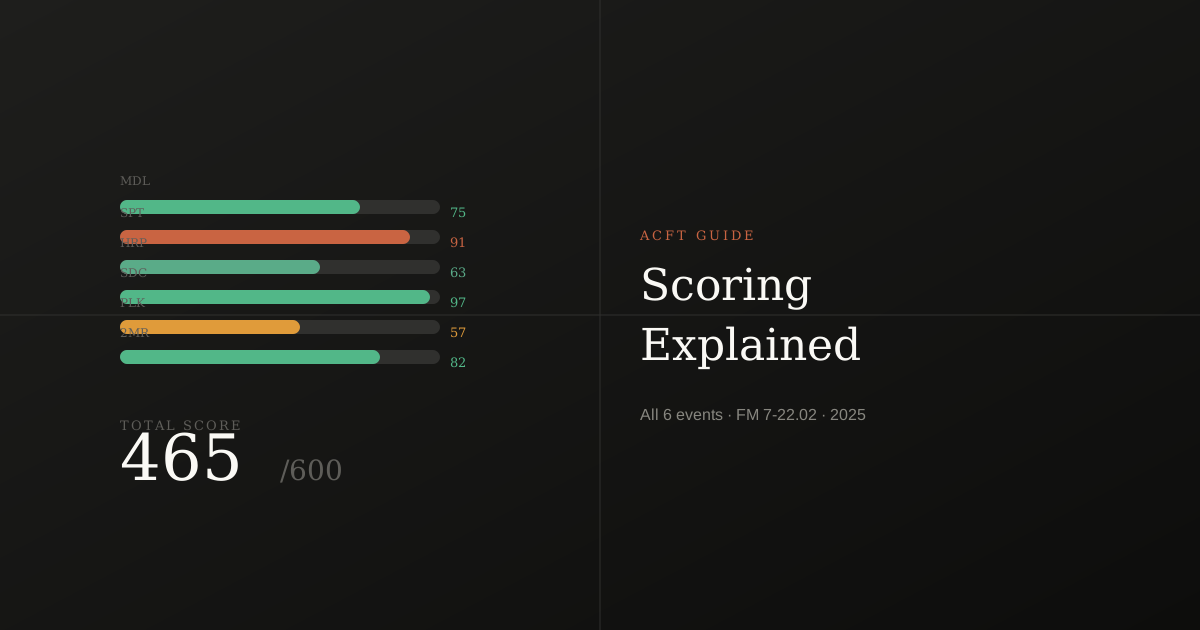
ACFT Scoring Guide: How the Army Fitness Test is Scored
Complete breakdown of all 6 ACFT events: scoring tables, pass/fail criteria, linear interpolation, a…
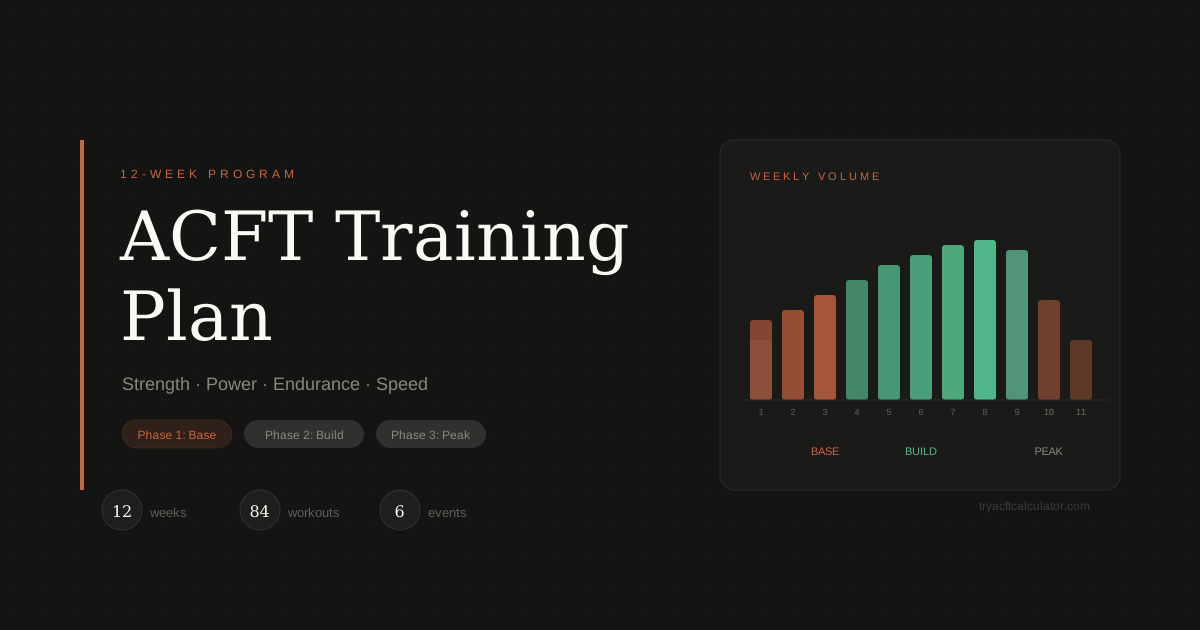
12-Week ACFT Training Plan to Max Your Score
Week-by-week ACFT training plan with periodization, event-specific programming, assessment week, nut…
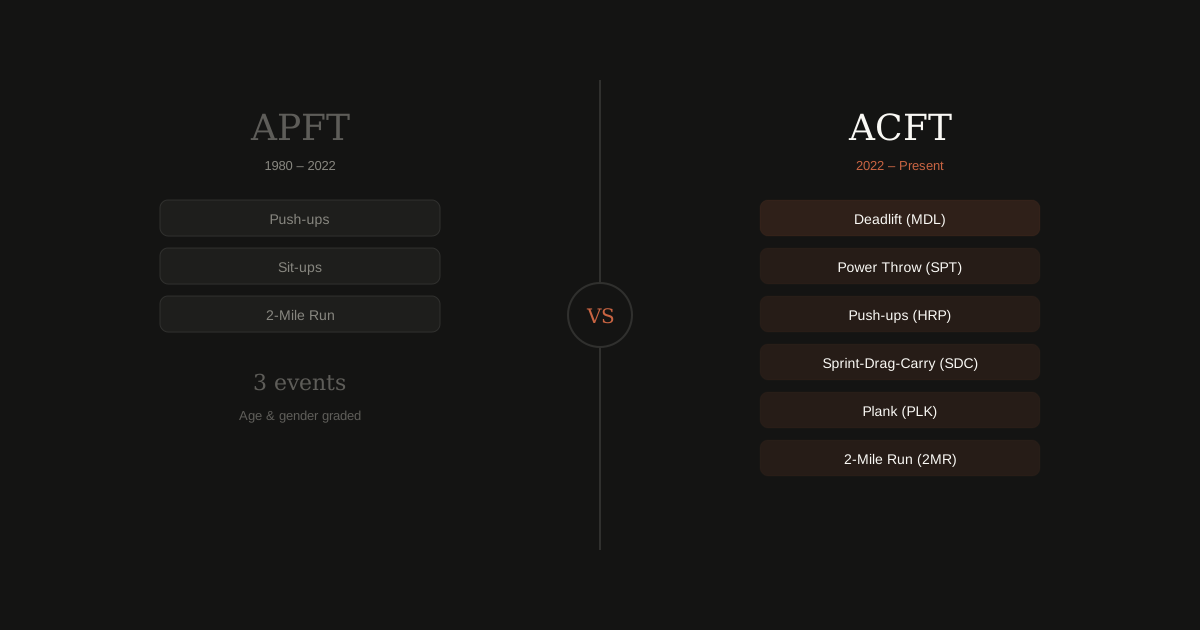
ACFT vs APFT: What Changed and Why It Matters
Side-by-side comparison of ACFT vs APFT: history, event differences, scoring philosophy, what got ha…