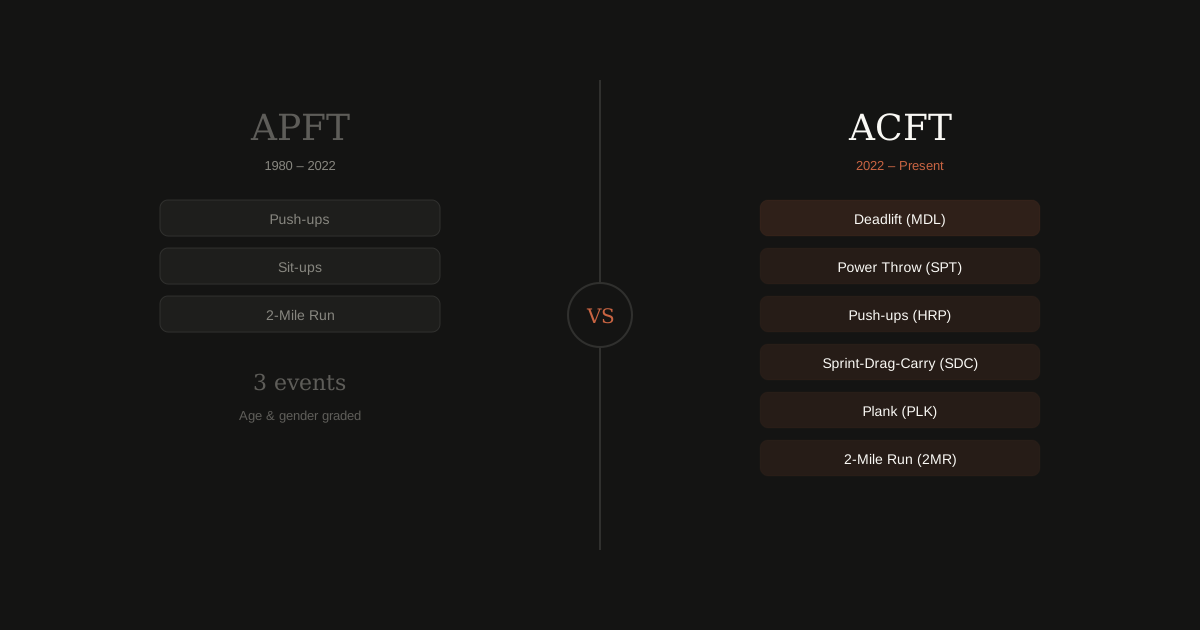
Side-by-side comparison of ACFT vs APFT: history, event differences, scoring philosophy, what got harder, and how to adapt.
If you served before 2022, you took the Army Physical Fitness Test. If you're serving now, you take the Army Combat Fitness Test. The two share one event (the two-mile run) and a general push-up movement, but almost everything else is different. The events, the scoring philosophy, the pass/fail criteria, and the physical demands on soldiers have all changed.
Understanding the differences isn't just history. It's practical knowledge that affects how you train, what weaknesses to prioritize, and how to interpret your scores relative to where you came from. Use the ACFT calculator to see where your current numbers stand under the new system.
A Brief History: Where the APFT Came From and Why It Had to Go
The Army Physical Fitness Test was introduced in 1980, replacing an earlier battery of physical assessments. For nearly 40 years, it defined Army fitness: two minutes of push-ups, two minutes of sit-ups, and a two-mile run, scored against age- and gender-adjusted tables.
The APFT wasn't bad by the standards of 1980s exercise science. But by the 2000s, significant problems had accumulated:
The sit-up problem: High-volume sit-ups with partner-anchored feet primarily train hip flexors, not the anterior core. Research repeatedly showed that this movement pattern, done at high volume, correlates with lumbar stress injuries. Sit-up injuries became one of the most common training-related injuries in the Army.
The functional gap: Push-ups and sit-ups and a two-mile run didn't assess the physical qualities most relevant to combat. Picking up a casualty (deadlift), throwing a grenade (explosive power), dragging someone to cover (strap drag), and sprinting with equipment (anaerobic conditioning) were untested.
The age/gender scaling problem: A 55-year-old general officer could score 300 on the APFT with a 19:30 run, a pace that would score well below passing under ACFT standards. This created scenarios where clearly inadequate fitness was obscured by favorable age/gender tables.
Development of the ACFT: In 2015, the Army began developing a replacement test grounded in occupational physical demands analysis. The work studied what physical tasks combat arms and support roles actually required, and what physical qualities predicted success at those tasks. The result was a six-event test that debuted in pilot form in 2018 and became the mandatory test in April 2022.
Side-by-Side Event Comparison
| APFT Event | Format | ACFT Equivalent | Format |
|---|---|---|---|
| Push-ups | 2-min max reps, standard form | Hand-Release Push-Ups (HRP) | 2-min max reps, hand must leave floor each rep |
| Sit-ups | 2-min max reps, partner holds feet | Plank (PLK) | Max hold, forearm plank |
| Two-Mile Run | Timed, measured course | Two-Mile Run (2MR) | Same format |
| (no equivalent) | N/A | 3 Rep Max Deadlift (MDL) | Hex bar, 3 reps at max weight |
| (no equivalent) | N/A | Standing Power Throw (SPT) | 10-lb med ball, overhead backward throw |
| (no equivalent) | N/A | Sprint-Drag-Carry (SDC) | 5-phase shuttle: sprint, drag, lateral, carry, sprint |
The ACFT kept the two-mile run nearly unchanged, modified push-ups with the hand-release requirement, replaced sit-ups with the plank, and added three entirely new events that have no APFT equivalent.
Scoring Philosophy: The Most Fundamental Change
The APFT and ACFT have fundamentally different scoring philosophies, and this is where the practical impact is greatest.
APFT Scoring System
- Three events: push-ups, sit-ups, 2-mile run
- Gender and age-adjusted tables: A 40-year-old woman needed significantly fewer push-ups and a slower run time than a 22-year-old man to earn the same score
- Minimum passing score: 60 points per event. But since each event was scored against an adjusted table, "60 points" meant very different physical performance for different soldiers
- Maximum possible score: 300 points (100 per event)
- Pass/fail: Fail any event = fail the test
ACFT Scoring System
- Six events
- Gender- and age-neutral standards: All soldiers held to identical performance standards regardless of gender or age
- Minimum passing score: 60 points per event, using universal tables
- Maximum possible score: 600 points (100 per event)
- Pass/fail: Fail any single event = fail the test
The shift to universal standards was the most debated change. The Army's position was grounded in the combat readiness argument: a casualty weighs the same whether it's a 24-year-old male or a 38-year-old female pulling them to cover. The physical demand doesn't scale. So the test shouldn't either.
Critics raised legitimate concerns about physiological differences in strength and cardiovascular capacity between men and women and different age groups. After the ACFT's initial rollout, the Army briefly returned to gender- and age-adjusted scoring in April 2022 following significant feedback from soldiers and NCOs. This reversal lasted only a few months before the Army reinstated gender-neutral standards, citing the original combat readiness rationale.
The current standard is gender-neutral. All soldiers are scored identically.
Event-by-Event Deep Dive
Push-Ups vs Hand-Release Push-Ups
APFT push-ups: Lower to at least 90 degrees of elbow bend, push back up. The up position (arms extended) was the only authorized rest position. You could pause in the up position but not in the down position.
ACFT hand-release push-ups: At the bottom of each rep, both hands must fully leave the ground (lifting off the surface). Only then can you press back up. This eliminates any possibility of quarter-rep or shallow movement and ensures full range of motion on every repetition.
The practical impact: most soldiers see their rep count drop 15 to 30% when switching from APFT to HRP format. A soldier who could do 60 APFT push-ups in two minutes will typically complete 42 to 52 HRPs in the same time. The hand release adds a moment of dead weight before each press, requiring more strength at the bottom position.
The ACFT minimum is 20 HRPs for 60 points, universal for all soldiers. APFT minimums varied widely by age and gender, from as few as 17 push-ups (older female soldiers) to 42 push-ups (22 to 26-year-old males) for a score of 60.
Use the push-ups calculator to find exactly how your HRP reps score.
Sit-Ups vs Plank
APFT sit-ups: Two minutes to perform as many sit-ups as possible. A partner held your feet. The full range of motion was lying flat to elbows touching knees. Common performance for passing soldiers was 50 to 80 sit-ups in two minutes.
ACFT plank: Hold a forearm plank position for as long as possible. No partner needed. The event ends when form breaks, whether hips sag, hips pike, knees touch, or elbows shift.
The sit-up was an inferior core assessment because hip flexors dominate the movement at high rep counts. The spine experiences repetitive flexion under load, which accumulates stress over years of training. The plank tests isometric core endurance with a neutral spine. It's a more functional assessment with a safer training profile.
For soldiers who built significant sit-up volume over years, the plank requires specific retraining. Sit-up volume has zero transfer to plank performance. Start holding planks immediately and add time progressively. Most soldiers can reach the 2:54 minimum within 4 to 6 weeks of consistent practice. See the detailed program in ACFT Plank Tips.
Two-Mile Run: Then vs Now
The format is essentially unchanged: run two miles on a measured outdoor course as fast as possible. No treadmills, no indoor tracks for official testing.
The key difference is in the scoring tables:
APFT 2MR (sample, 22 to 26-year-old male):
- Minimum pass (60 pts): 18:54
- 100 points: 13:00
APFT 2MR (sample, 22 to 26-year-old female):
- Minimum pass (60 pts): 21:42
- 100 points: 15:36
ACFT 2MR (all soldiers, universal):
- Minimum pass (60 pts): 14:54
- 100 points: 13:30
This is a major change for older soldiers and female soldiers who had more relaxed run standards under the APFT. A 40-year-old male under the APFT needed only about 18:42 for a score of 60. Under the ACFT, that same soldier needs 14:54, nearly four minutes faster. The ACFT 2MR is genuinely harder for a large portion of the force.
Use the two-mile run calculator to confirm what your current run time scores.
The Three New Events
3 Rep Maximum Deadlift (MDL)
The deadlift was the most significant addition to the ACFT. There is no APFT equivalent, meaning any soldier who never specifically trained strength had to learn a new movement from scratch.
The hex bar (trap bar) is used rather than a straight barbell. The minimum passing weight is 205 lbs for 60 points. Many soldiers who were never exposed to strength training initially struggle with this event, but the hex bar deadlift is highly trainable. Most soldiers can reach 205 lbs within 8 to 16 weeks of consistent practice.
The MDL represents a philosophical shift: combat fitness requires strength, not just endurance. Soldiers carry 60 to 100+ lb loads, handle casualties, and move equipment. The deadlift tests whether a soldier can generate significant force from the ground. That's a fundamental combat task.
Standing Power Throw (SPT)
A 10-pound medicine ball is thrown overhead and backward for maximum distance. Two attempts are allowed and the longer throw counts. The minimum passing distance is 7.3 meters for 60 points.
This event tests explosive power, the ability to generate rapid, maximal force. It correlates with athletic performance, grenade throwing range, and the explosive demands of combat maneuvering. It has no direct APFT equivalent, though soldiers from athletic backgrounds adapt quickly.
Sprint-Drag-Carry (SDC)
Five phases over 50 meters total: sprint 25m, drag a 90-lb sled 25m backward, lateral shuffle 25m each direction, carry two 40-lb kettlebells 25m, and sprint 25m. The minimum passing time is 2:12 for 60 points.
The SDC is often considered the most physically demanding single event in the ACFT because of its combination of demands: short-burst sprinting, grip-intensive dragging, agility, loaded carrying, and repeated anaerobic efforts with no rest between phases. It directly simulates casualty rescue and equipment movement under time pressure.
Who Benefits and Who Faces New Challenges
Soldiers Who Benefit from the ACFT vs APFT
Stronger soldiers: If you always had significant strength but mediocre aerobic capacity, the APFT punished you because 66% of the test was endurance. The ACFT gives you the MDL and SPT to score high on, partially offsetting a slower run.
Older soldiers who maintained strength: A 45-year-old who has maintained significant strength and moderate aerobic fitness may score better on the ACFT than on the APFT, especially if they struggled with the APFT run's time pressure for their age group but can deadlift 280+ lbs.
Athletic background soldiers: Former athletes in power sports (wrestling, football, track field events) often adapt quickly to the MDL and SPT, which reward athletic movement patterns they've trained for years.
Soldiers Who Face New Challenges
Soldiers who relied on age/gender adjustments: The APFT's adjustments let some soldiers pass with performance levels that would fail the ACFT. This group faces the steepest adaptation curve.
Soldiers without strength training backgrounds: The MDL requires learning and training a completely new movement. Without any strength training history, reaching 205 lbs requires dedicated effort over months.
Soldiers who trained exclusively for the APFT: Years of running and push-ups builds aerobic endurance and pressing volume, but does nothing for deadlift strength, explosive power, or anaerobic conditioning. The training programs are fundamentally different.
Training Adaptations: Moving from APFT to ACFT
If you're transitioning from APFT-focused training to ACFT-focused training, these are the key shifts to make:
Add structured strength training immediately. The deadlift and power throw require dedicated strength work that APFT training never demanded. A minimum of 2 to 3 strength sessions per week centered on hex bar deadlifts, kettlebell work, and loaded carries is the fastest path to MDL and SPT improvement.
Replace sit-up training with plank holds. Sit-up volume has zero transfer to plank performance. Make the switch immediately and add time progressively. Most soldiers can reach the 2:54 minimum within 4 to 6 weeks.
Modify your push-up practice. The hand-release requirement changes the rhythm and demands more strength at the bottom of the press. Practice HRPs specifically, not standard push-ups, for at least 4 weeks before testing.
Add SDC-specific conditioning. Nothing quite replicates the SDC except practicing the SDC. Build the components separately (sprints, sled drags or heavy kettlebell drags, lateral shuffles, loaded kettlebell carries), then practice the full event sequence. See the complete SDC strategy guide for detailed drills.
Your 2MR training fundamentally stays the same, but your target pace changes. If you ran an APFT-minimum 18:30 for your age group, you now need to reach 14:54. That requires genuine aerobic development, not just APFT maintenance.
Prioritize weakest events ruthlessly. Under the APFT, a strong runner could offset a mediocre push-up score. Under the ACFT, you can't. Every event must independently pass at 60 points. Use the ACFT calculator to score all your events and identify which ones need the most work.
What a 300 APFT Score Means on the ACFT
A common question from soldiers transitioning between systems: "If I maxed the APFT, what should I expect on the ACFT?"
There is no direct conversion, but some general patterns hold:
- A soldier who ran a 13:00 two-mile run (max APFT 2MR) will likely score 90 to 100 on the ACFT 2MR
- A soldier who did 80+ push-ups (APFT max) will likely score 70 to 85 on HRPs (some reduction from hand-release requirement)
- The sit-up max has essentially zero predictive value for PLK score. They are different movements.
- MDL, SPT, and SDC scores for a former APFT-only soldier are completely unpredictable without testing. They may score anywhere from 40 to 90 depending on athletic background.
The lesson: don't assume APFT excellence translates to ACFT excellence. Test yourself on all six events, find the gaps, and train them specifically. The ACFT calculator will show you your real numbers without guesswork.
The Leg Tuck: What Most People Have Wrong
The APFT-to-ACFT transition story is often told as APFT → ACFT. The full story has one more step: ACFT Version 1 (2018 to 2022) → ACFT Version 2 (2022 to present).
The original ACFT included a leg tuck as the core event, not a plank. The leg tuck required hanging from a pull-up bar and raising your knees to your elbows. It tested pulling strength and core flexion simultaneously.
When scaled Army-wide, the leg tuck revealed two problems:
- High female failure rates: The upper-body pulling strength required meant a disproportionate number of female soldiers failed this single event
- Grader inconsistency: The definition of "knees to elbows" was applied inconsistently, creating fairness concerns
The Army replaced the leg tuck with the plank in 2022 simultaneously with the broader ACFT rollout. So the current ACFT is not the same test that was piloted in 2018. Soldiers reading early ACFT training guides should note this difference.
For a complete guide to training the current ACFT, see the 12-Week ACFT Training Plan. For how the new scoring system works in detail, see the ACFT Scoring Guide.
Frequently Asked Questions
Was the ACFT ever temporarily reversed? Yes. In April 2022, the Army briefly returned to gender- and age-adjusted scoring while reviewing feedback on the universal standards. This reversal lasted only a few months before the Army reinstated gender-neutral scoring, which is the current standard.
Is the APFT still used anywhere in the Army? No. The APFT is no longer an authorized Army fitness test. All record fitness tests are conducted using the ACFT. Historical APFT scores remain in personnel records but are no longer used for current assessments.
Are ACFT standards harder than APFT standards overall? For many groups, yes, particularly older soldiers and female soldiers who benefited from the APFT's age/gender adjustments on the run and push-ups. For younger male soldiers who were already training at higher intensities, the ACFT can actually be more favorable because the deadlift and power throw reward existing strength. The answer depends on the individual soldier's fitness profile.
What happened to the leg tuck? The leg tuck was part of the original ACFT pilot (2018 to 2022) but was replaced by the plank in 2022 due to high failure rates and standardization challenges. The current ACFT does not include a leg tuck.
How does total score compare between tests? The APFT maximum was 300 (100 per event × 3 events). The ACFT maximum is 600 (100 per event × 6 events). You can't directly compare totals between the two tests. Focus on per-event scores and whether you're meeting the 60-point minimum on each ACFT event.
Free Calculator
Ready to check your score?
Use the free ACFT calculator to instantly score all 6 events based on official FM 7-22.02 standards.
Open ACFT Calculator →Related Articles
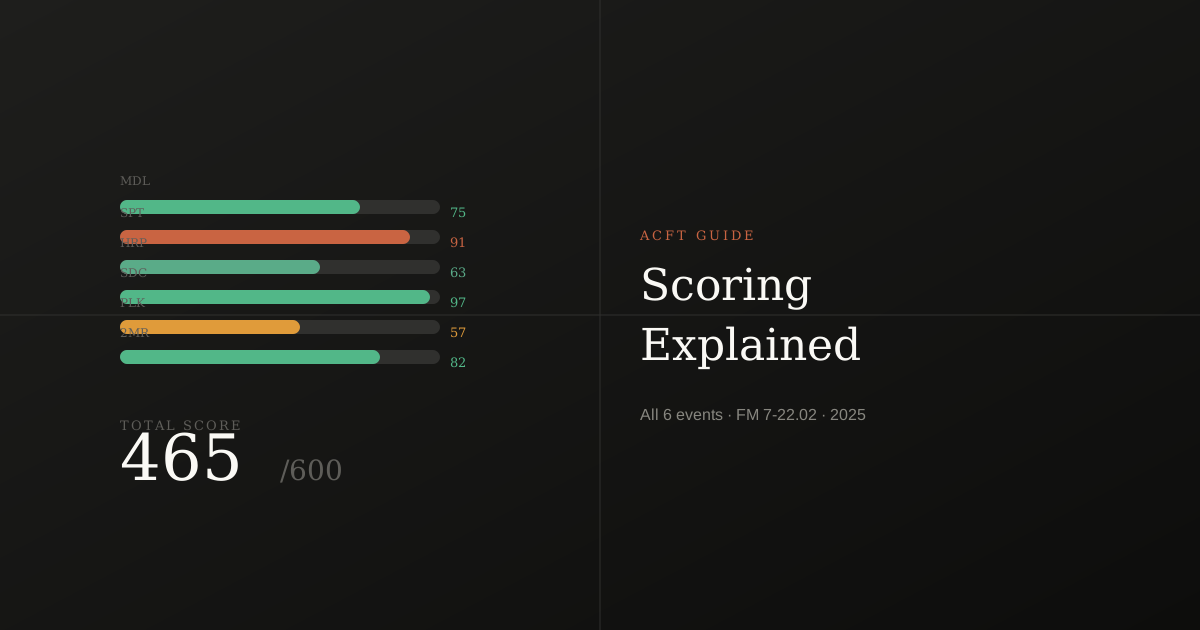
ACFT Scoring Guide: How the Army Fitness Test is Scored
Complete breakdown of all 6 ACFT events: scoring tables, pass/fail criteria, linear interpolation, a…
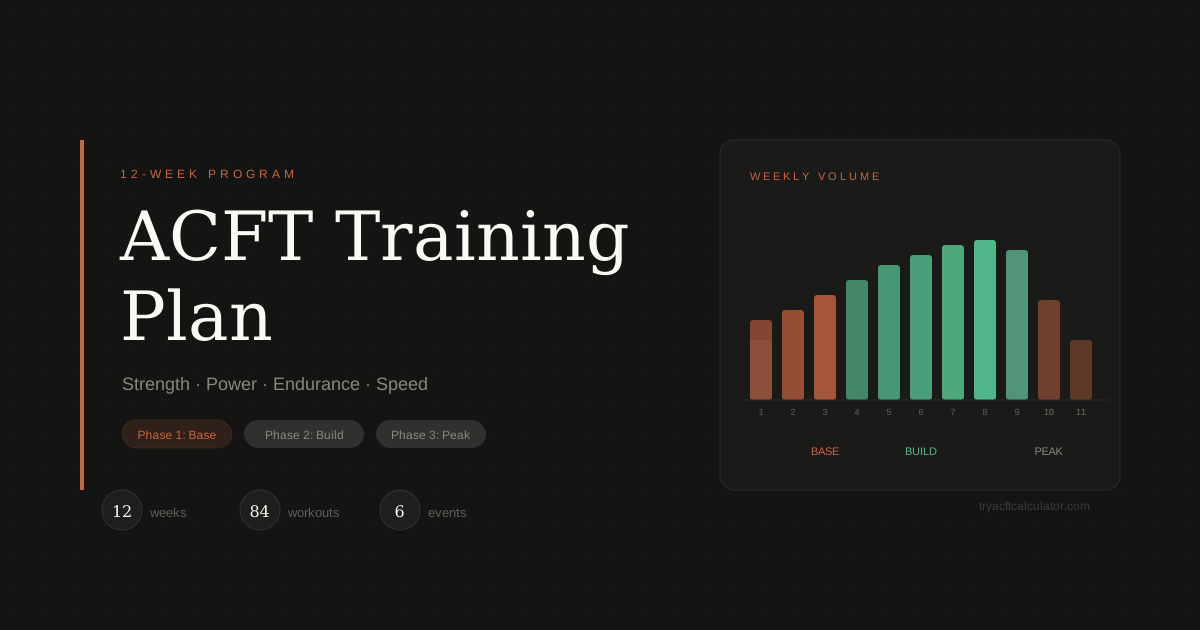
12-Week ACFT Training Plan to Max Your Score
Week-by-week ACFT training plan with periodization, event-specific programming, assessment week, nut…
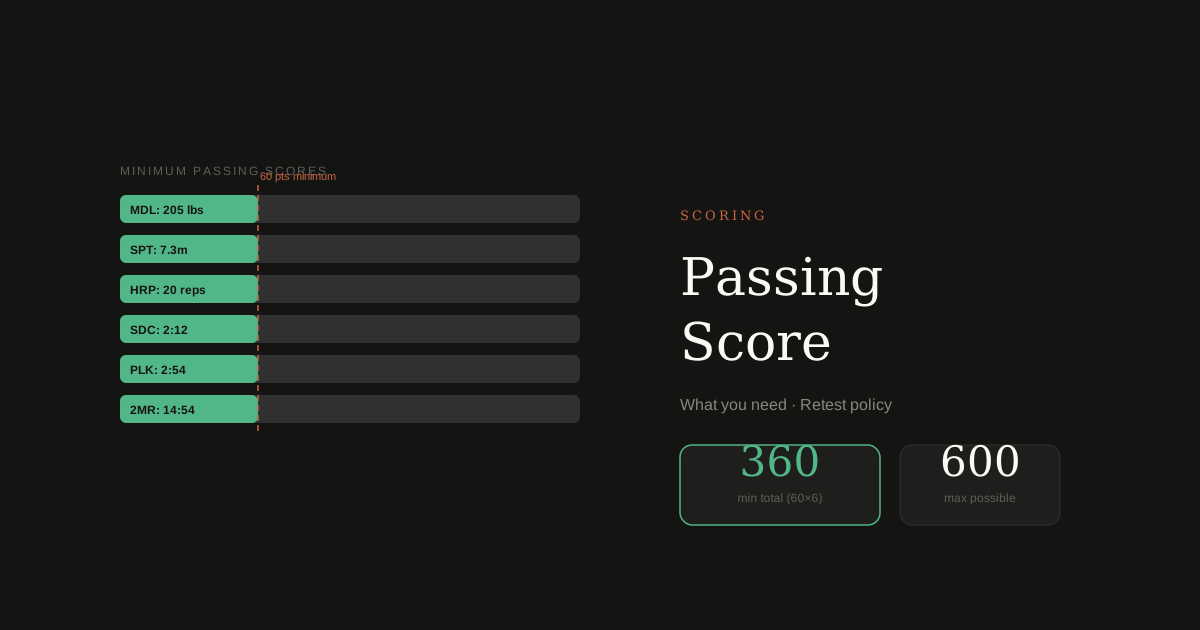
ACFT Passing Score: Minimums, Requirements & Retest Policy
Everything you need to know about ACFT minimum scores, per-event passing thresholds, what a perfect …