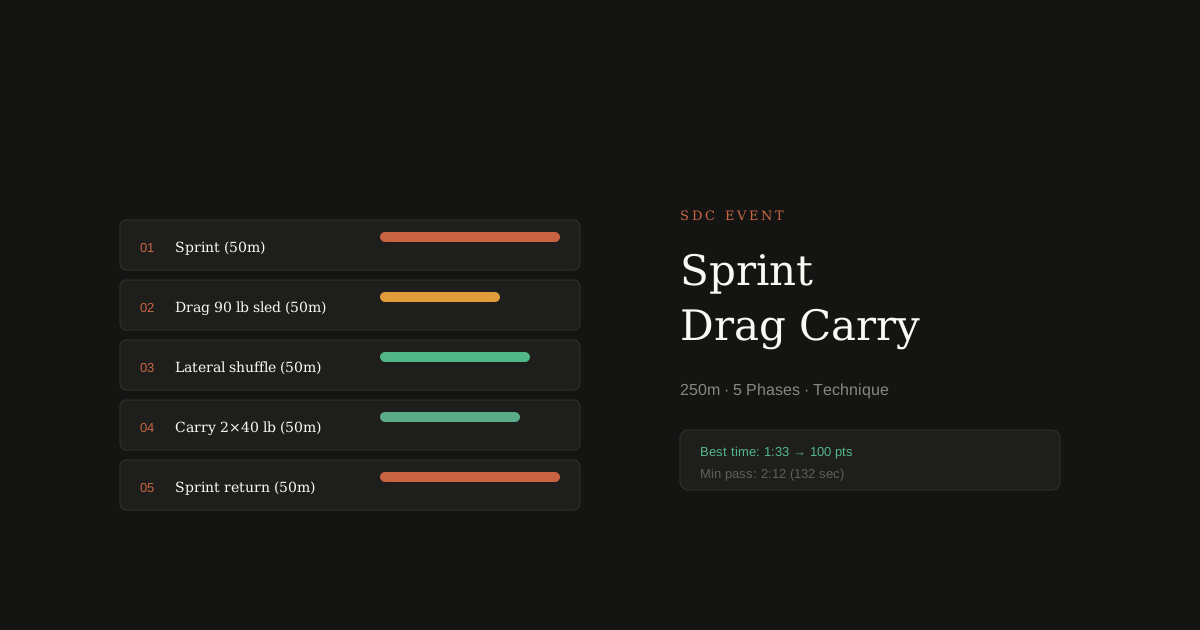
Master every phase of the ACFT Sprint-Drag-Carry: setup, transitions, lane technique, conditioning drills, and cutting real time.
The Sprint-Drag-Carry is the most complex event on the ACFT. You get five separate physical tasks across a 25-meter lane, five transitions where time bleeds away, and a relentless clock. All of it packs into roughly 90 seconds. It's the event soldiers most commonly underestimate, and the one where technical preparation pays off the most. Soldiers who score 2:05 and soldiers who score 2:25 on the SDC are often not dramatically different in fitness level. They're dramatically different in technique and transition execution.
Check your current time with the SDC calculator and see how it affects your total using the ACFT calculator.
SDC Layout, Rules, and Scoring
The course is set on a 25-meter lane. You complete five tasks, each consisting of 25 meters out and 25 meters back:
- Sprint: Run 25m out, sprint 25m back to the start line
- Drag: Drag a 90-lb sled 25m out, drag it back 25m
- Lateral: Shuffle laterally 25m in each direction (no crossover step)
- Carry: Pick up two 40-lb kettlebells and carry them 25m out and 25m back
- Sprint: Run 25m and cross the finish line
Total distance: roughly 250 meters of mixed-mode movement.
The clock starts with your first movement and stops when you cross the finish line after the final sprint.
Full SDC scoring table (selected values):
| Time | Points |
|---|---|
| 1:33 | 100 (maximum) |
| 1:36 | 95 |
| 1:39 | 90 |
| 1:42 | 88 |
| 1:54 | 80 |
| 2:00 | 76 |
| 2:06 | 72 |
| 2:12 | 60 (minimum pass) |
| 2:15 | 58 |
| 2:21 | 50 |
| 2:30 | 38 |
| 3:00+ | 0 |
Every 3 seconds in the 2:00 to 2:12 range is worth about 2 points. In the sub-2:00 range, every 3 seconds is worth 2 to 4 points. Time savings turn directly into score.
The minimum passing time of 2:12 is a real conditioning challenge for unprepared soldiers. But the difference between a 2:12 and a 2:00 is often as much about technique and transition efficiency as raw fitness.
Equipment: What You're Working With
The sled: 90 pounds. This doesn't change based on gender, age, or MOS. It's a standard dragging sled with a strap or rope harness attached. The weight stays constant.
The kettlebells: Two 40-lb kettlebells, one per hand (80 lbs total carried). Same weight for all soldiers.
Understanding the equipment before your first practice matters. If you've never dragged a 90-lb sled or carried 40-lb kettlebells for 25 meters, your first exposure should not be during your record ACFT.
Phase-by-Phase Technique Guide
Phase 1: Opening Sprint (25m out, 25m back)
The opening sprint is pure acceleration. You go from a dead stop to maximum speed over 25 meters, decelerate, pivot, and sprint 25 meters back.
Starting position: Athletic stance with feet staggered, weight forward over your front foot, arms ready to drive. Don't stand straight upright. Lean forward into a sprint acceleration position immediately.
Acceleration mechanics:
- Drive your arms hard from the first step. Arm drive determines leg speed, especially in short-distance acceleration.
- Stay low in the first 5 to 8 steps. A tall, upright posture in the acceleration phase loses ground force transfer. Drive forward and up.
- By 15 meters you should be at or near top speed for this distance.
The turn:
- Decelerate actively in the final 3 to 4 meters. Don't coast into the cone, which requires a long braking distance. Active deceleration means you can plant sooner.
- Plant your outside foot, generate a powerful push-off in the new direction, and explode back without a pause.
- Your body should not come to a complete stop at the cone. The turn is a plant-and-drive, not a stop-and-restart.
Transition to drag: After the return sprint, you transition immediately to the drag. As you cross the start line, don't fully stop. Redirect your momentum toward the sled. Every second of standing upright between the sprint and the drag is wasted time.
Phase 2: The Drag (25m out, 25m back)
The drag is where most soldiers lose the most time, and most of that loss is due to technique. Specifically, standing upright and pulling with their arms.
The physics: A 90-lb sled dragged across a surface creates significant resistance. Your legs and hips, your largest and most powerful muscle groups, can generate far more force against that resistance than your arms and upper back can. Soldiers who drag from a low, leg-driven position consistently outperform soldiers who drag standing upright.
Correct technique:
- Back to the direction of travel (you drag backward, looking over your shoulder or at the sky, not at where you came from)
- Hips low, roughly a half-squat to quarter-squat position throughout
- Lean your body backward into the direction of travel, creating a diagonal line from feet to shoulders
- Drive powerfully with your legs, taking short, powerful steps
- Keep your arms relatively straight and the strap taut. Your arms hold the strap, they don't row it.
- Don't let any slack develop in the strap. Slack means you must re-accelerate the sled from rest each step, which is significantly harder than keeping it in motion.
The biggest drag error: Standing upright and attempting to pull with your arms. This converts the drag into an upper-body back exercise. The resistance of the sled will win that contest every time, and you'll slow dramatically by the midpoint.
At the far cone: Pull the sled all the way until it has cleared the line, then pivot and drag back. The return drag is identical to the outgoing drag: same low position, same leg-drive priority.
Grip fatigue during the drag: Your grip will be challenged by the end of the drag. The strap or handle requires constant gripping under tension. This grip demand carries directly into the kettlebell carry phase. If your grip fails during the drag and you drop the strap repeatedly, you lose seconds on each restart. Specific grip training (dead hangs, heavy farmer carries, towel pull-ups) is essential SDC preparation.
Phase 3: Lateral Shuffle (25m left, 25m right)
The lateral shuffle requires purely lateral movement. No crossover steps at any point. A crossover step is an immediate fault and that portion must be re-done.
Efficient shuffle mechanics:
- Stay low throughout: hips bent, knees slightly bent, athletic stance maintained
- Push off the trailing foot to generate lateral force. The common error is dragging the trailing foot along passively. You should be actively pushing, not sliding.
- Keep feet roughly shoulder-width apart throughout. Feet that close together (< 1 foot apart) increase stumbling risk. Feet too far apart reduce the power per step.
- At each cone: decelerate, plant your outside foot, and push off in the new direction without fully stopping.
The temptation to rest: The lateral shuffle comes after the drag and is less obviously demanding, so many soldiers instinctively stand up and rest their hip flexors and upper body during this phase. Resist this. Standing upright during the lateral phase requires additional time to re-enter the athletic shuffle position, and upright shuffling is slower. Stay low the entire time.
Counting steps: Some soldiers lose track of the lateral direction at the cone and pivot the wrong way. Know which direction you start (it will be designated at the test site). Practice until the pivot direction is automatic.
Phase 4: The Kettlebell Carry (25m out, 25m back)
The carry requires picking up two 40-lb kettlebells at the same time and carrying them for 50 meters total without setting them down mid-phase (you set them down at the far cone and the return line only).
Pickup technique:
- Stand between the two kettlebells
- Squat down and grip both at once. Don't grab one and then the other.
- Drive your legs to stand up with both kettlebells at once
- The 1 to 2 seconds you save by picking up both at the same time adds up across practice reps and matters on the real test
Carry mechanics:
- Stand tall with shoulders back. Let the kettlebells hang at your sides.
- Grip firmly but not crushing. You need your grip to last through this phase and still let you sprint at the end.
- Walk fast and controlled, not running. Running with 40-lb kettlebells risks dropping one, and a dropped kettlebell must be picked up (losing 2 to 5 seconds).
- At the far cone: set both kettlebells down at the same time (not dropped from height, but not lowered slowly either. A controlled, fast placement).
- Pick them back up and return
Grip endurance across the drag and carry: The SDC creates a sequential grip demand. The drag strap loads your grip first, and then the kettlebells demand grip endurance from an already-fatigued forearm. This is a known challenge of the SDC design. Soldiers who haven't specifically trained grip endurance often find their forearms cramping or grip slipping by the time the kettlebells go in their hands. Training farmers carries with 40+ lbs per hand builds the specific grip endurance you need.
Phase 5: Final Sprint (25m to finish)
This is the final event. You're already 4 phases deep, your lungs are burning, your legs are heavy, and you have a 25-meter sprint left between you and your time.
Keys for the final sprint:
- Start sprinting from the moment you set down the kettlebells. Don't walk the first 3 to 5 meters to "catch your breath." This is where your time is made or lost for the minimum/maximum thresholds.
- Pump your arms aggressively. When the legs are fatigued, arm drive is the most reliable way to maintain stride turnover.
- Don't look at your watch or the timer. Look at the finish line.
- Run through the line, not to it. Soldiers who slow before the line lose time. Soldiers who sprint through it don't.
Mental cue: The last sprint is pure execution. You've done all five phases. There is one more task. The level of discomfort you feel at this moment doesn't matter. Drive through it.
Transition Mastery: Where the Clock Is Really Won or Lost
The five phase transitions are invisible time-wasters. Between each phase, there's a moment where you change tasks. Every wasted movement in those moments adds to your total time.
Quantified example: 5 transitions x 2 extra seconds per transition = 10 additional seconds. For a soldier aiming for 2:10, 10 seconds is the difference between passing and failing. For a soldier targeting 2:00, it's 5 points.
How to practice transitions:
- Walk the course before your record test and physically rehearse each pivot and transition
- Practice slow-speed run-throughs specifically focused on the transitions, not the phases themselves, but the moments between them
- Video yourself from above if possible. Transition waste is often invisible to the athlete but obvious on video.
Cone awareness: Knocking a cone over requires resetting it before continuing, a 3 to 5 second penalty that can end a sub-2:00 attempt. In transition practice, focus on keeping at least 2 feet of clearance between your body and the cones at each pivot.
6-Week SDC Conditioning Block
Add this conditioning work to your regular training schedule. Frequency: 3 sessions per week.
Weeks 1 and 2: Build Course Familiarity
Session 1:
- 3 x full SDC practice runs at 80% effort, 3-minute rest between sets
- Focus: correct technique for each phase, not time
- Supplement: 4 x 25m sled drag at 80% effort, 90-second rest
Session 2:
- Grip and carry work: 4 x 50m farmer carry (40+ lbs per hand), 2-minute rest
- Lateral shuffle: 4 x 50m (25m each direction), 60-second rest
- Sprints: 6 x 50m sprint (25m out, 25m back), 45-second rest
Session 3:
- 3 x partial SDC (sprint + drag only), 2-minute rest
- Review technique from session 1 video
Weeks 3 and 4: Build Intensity
Session 1:
- 4 x full SDC practice runs at 90% effort, 4-minute rest
- Time yourself and track improvements
- Supplement: 5 x 25m sled drag at maximum effort, 2-minute rest
Session 2:
- Heavy farmer carries: 4 x 40m (50+ lbs per hand), 2-minute rest
- Shuttle sprints: 8 x 50m sprint, 45-second rest
- Prowler push (if available): 4 x 25m, 2-minute rest (strong SDC conditioning)
Session 3:
- 2 x full SDC at maximum effort, 6-minute rest
- Compare times week-over-week
Weeks 5 and 6: Peak and Taper
Session 1:
- 3 x full SDC at maximum effort, 5-minute rest
- This is your primary performance week. Note your best time.
Session 2:
- Maintenance: shuttle sprints and farmer carries at moderate effort
- No maximum SDC efforts this session
Session 3 (week 5 only):
- 2 x full SDC for feel, not maximum effort
- Focus on smooth transitions, not time
Week 6 (taper):
- 2 sessions, not 3
- Reduce SDC volume: 1 to 2 sets at controlled effort
- No maximum-effort sled drags within 4 days of record test
- Maintain grip work: 2 x 50m farmer carry at moderate weight
Grip Endurance: The Hidden SDC Limiter
Grip failure is the most common unexpected SDC time-waster for soldiers who haven't trained specifically for it. The drag strap demands 90+ seconds of sustained grip tension. The kettlebell carry requires another 60+ seconds. For a soldier whose grip isn't specifically prepared, the forearms start to fail around the midpoint of the carry.
Specific grip training for the SDC:
| Exercise | Sets/Reps | Frequency | Target |
|---|---|---|---|
| Dead hang (dead bar hang) | 3 x max hold | 3x/week | Builds sustained grip endurance |
| Farmer carry (40+ lbs/hand) | 4 x 50m | 2x/week | Direct carry transfer |
| Towel pull-ups or rope pull-ups | 3 x 5 to 8 | 2x/week | High-intensity grip strength |
| Plate pinch | 3 x 30-sec hold | 2x/week | Fingertip and pinch grip |
| Barbell holds | 3 x 30 to 60 sec | 2x/week | Crush grip endurance |
Most soldiers can meaningfully improve their grip endurance in 4 to 6 weeks of consistent training. Don't neglect this. It directly translates to SDC performance.
Sled Drag Training Without a Sled
Most training environments don't have a 90-lb competition sled available for daily practice. Here are effective substitutes:
Heavy sled or tire drag: A weighted sled with a standard plate adds equivalent resistance. A 90-lb tire drag works similarly and is often available at military bases.
Partner drag with resistance: A training partner lying on a tarp or smooth surface can approximate sled resistance. This is less consistent but works in field environments.
Resistance band drag: Anchoring a heavy resistance band at floor level and dragging against it builds the pattern and conditioning. The resistance profile differs from a sled (band resistance increases with distance pulled), but it builds the hip-low, leg-drive pattern.
Backward sled walk: Using a weight belt with a chain attached to a plate dragged across a gym floor. Rough but functional.
For the carry, any two objects of equal weight (sandbags, loaded duffel bags, water jugs) can replace kettlebells for conditioning work.
Pre-Test Checklist
In the days before your SDC record test, run through this checklist:
- Have I practiced the full course at least 5 to 10 times in training?
- Do I know which direction the lateral shuffle starts?
- Have I trained grip endurance specifically?
- Am I comfortable picking up both kettlebells at the same time?
- Have I practiced keeping the strap taut throughout the drag?
- Do I know my current best SDC time?
- Am I rested, with no maximum SDC efforts in the last 4 days?
For full ACFT event coverage and an integrated training plan, see the ACFT Scoring Guide and the 12-Week ACFT Training Plan. For context on passing scores and what they mean for your career, see the ACFT passing score guide.
Frequently Asked Questions
What is the sled weight for the ACFT SDC drag?
The sled weighs 90 pounds. This weight doesn't change based on soldier gender or age.
Can I run during the lateral shuffle phase?
No. A crossover step or any running motion (feet crossing each other) during the lateral phase is a fault. Only lateral shuffle steps are permitted. If a grader calls a fault, you must repeat that direction of the shuffle.
Can I drop the kettlebells at the far cone?
You must set them down, not throw or drop them aggressively. A controlled, quick placement is fine. You can't drop them from waist height. A dropped kettlebell that rolls may need to be repositioned, costing additional seconds.
What are the kettlebell weights for the carry?
Each kettlebell is 40 lbs, for a total carry load of 80 lbs. You carry one in each hand.
How should I breathe during the SDC?
Breathe continuously throughout the entire event. Many soldiers instinctively hold their breath during the drag phase when exerting maximum effort. This is counterproductive. Sustained breath-holding speeds up fatigue and reduces oxygen delivery. Exhale during the most physically demanding moments (the initial pull on the sled, picking up the kettlebells) and breathe continuously between those moments.
Where does the SDC rank in difficulty among the six ACFT events?
It varies by soldier background, but the SDC consistently shows among the highest failure rates of the six events. Its combination of strength, speed, grip endurance, and precise transition mechanics with five distinct physical modes makes it uniquely demanding. Soldiers who neglect the SDC in training and rely only on their general fitness level routinely underperform relative to their overall fitness. Specific preparation is required.
How much can I improve my SDC time with 6 weeks of specific training?
Most soldiers who train the SDC specifically see improvements of 10 to 25 seconds over a 6-week block. Soldiers with significant technique flaws (upright dragging, slow transitions, grip issues) often see larger improvements (20 to 35 seconds) once the technique corrections are made. Soldiers already under 2:00 may see smaller absolute gains (8 to 15 seconds), but those gains are worth meaningful point increases at that scoring level.
Free Calculator
Ready to check your score?
Use the free ACFT calculator to instantly score all 6 events based on official FM 7-22.02 standards.
Open ACFT Calculator →Related Articles

ACFT Scoring Guide: How the Army Fitness Test is Scored
Complete breakdown of all 6 ACFT events: scoring tables, pass/fail criteria, linear interpolation, a…
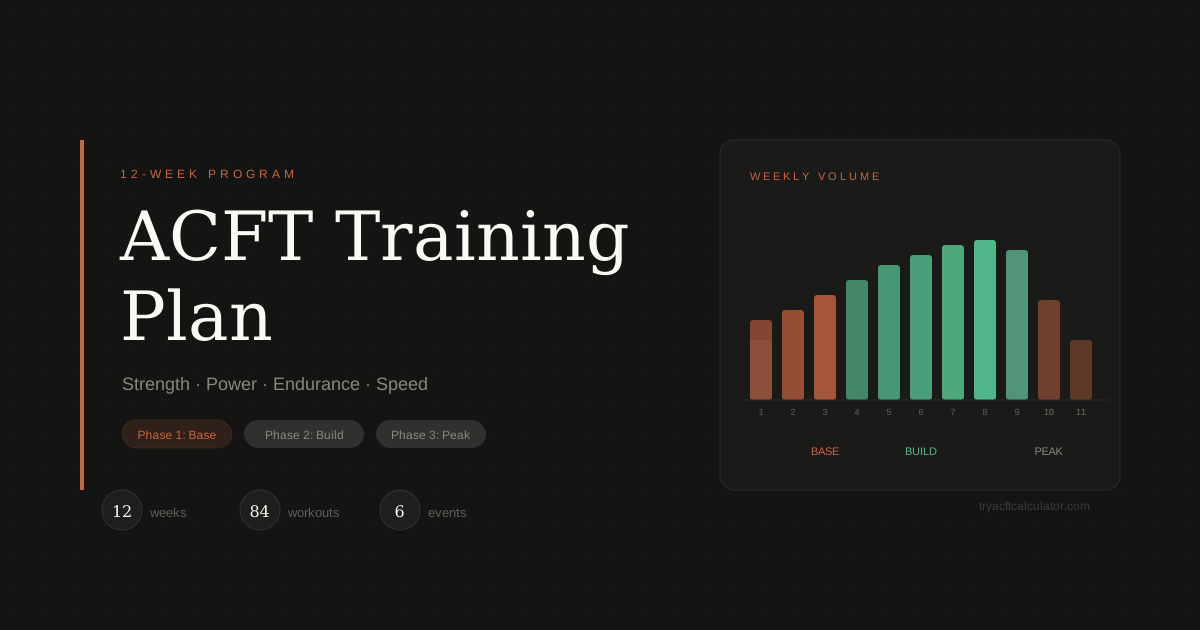
12-Week ACFT Training Plan to Max Your Score
Week-by-week ACFT training plan with periodization, event-specific programming, assessment week, nut…
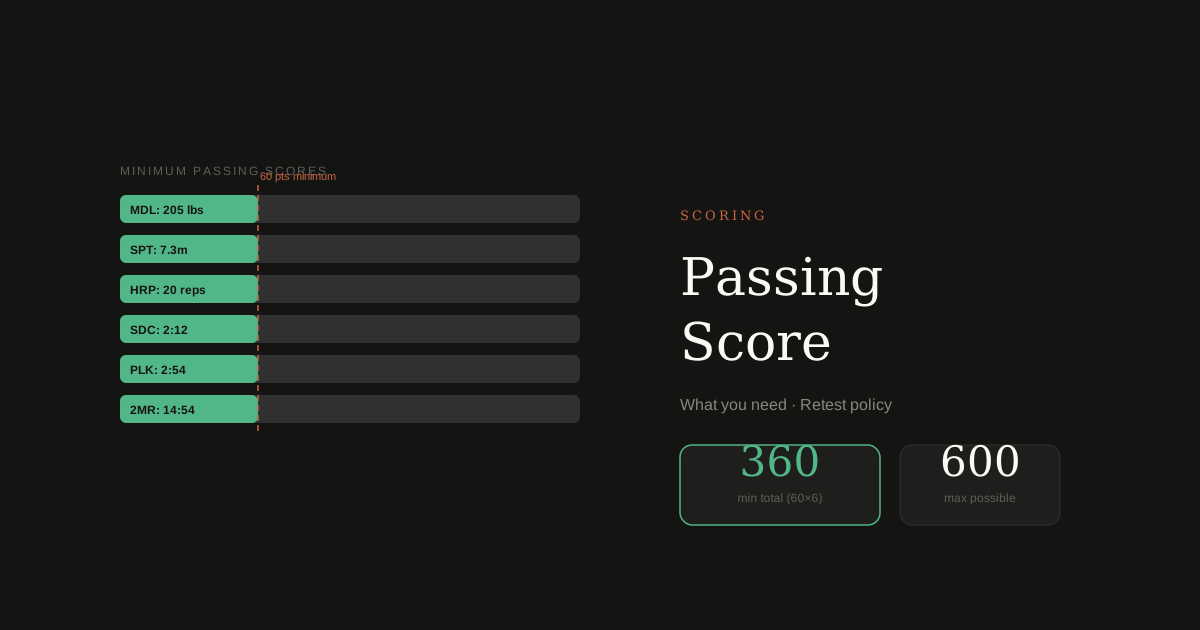
ACFT Passing Score: Minimums, Requirements & Retest Policy
Everything you need to know about ACFT minimum scores, per-event passing thresholds, what a perfect …