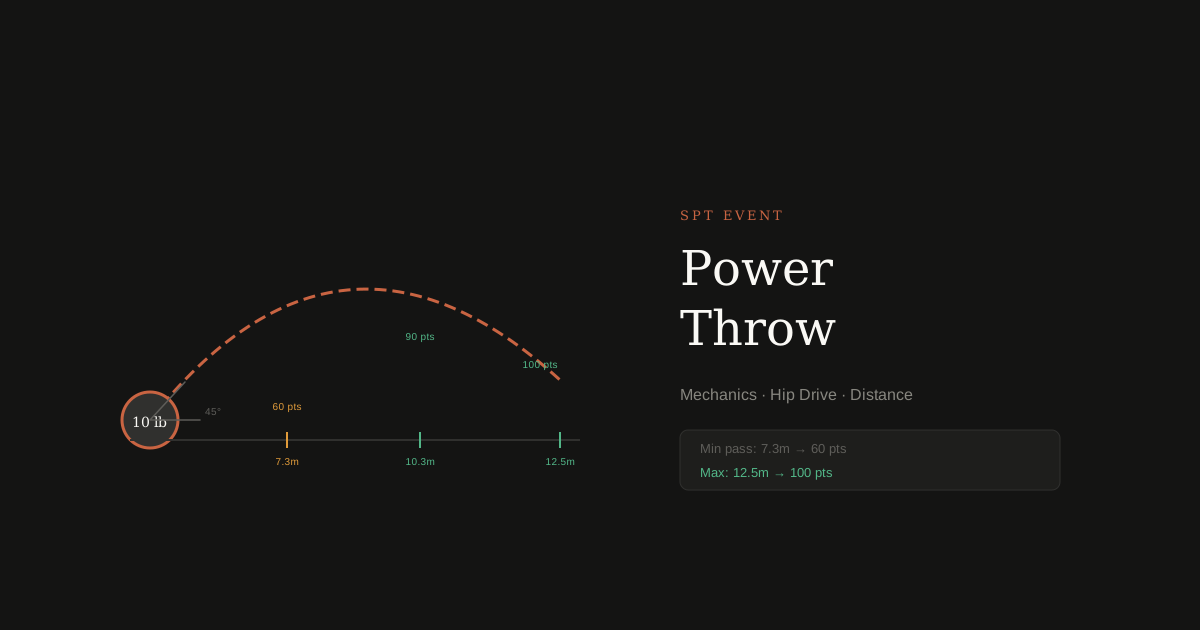
ACFT Standing Power Throw technique: hip drive, release angle, medicine ball training, and common faults that kill distance.
The Standing Power Throw is the ACFT's pure power event. A 10-lb medicine ball thrown overhead and backward for maximum distance. Of the six ACFT events, the SPT is the most technique-dependent. Soldiers with similar strength levels can differ by 2 to 3 meters based on technique alone, a gap worth 20+ points on the scoring table. If you're struggling to clear 7.3 meters (the minimum passing distance), the fix is almost certainly technique before fitness. If you're clearing 8 meters and want to push toward 10, a mix of technique refinement and targeted power training will get you there.
Check your current distance with the power throw calculator, then see your full score at the ACFT calculator.
SPT Rules, Setup, and Scoring
You get two attempts (throws). The longer of the two counts. You must throw from behind the designated line, and you can't step forward out of the throwing zone before the ball leaves your hands.
The ball weighs 10 pounds (4.5 kg). All soldiers use the same ball regardless of gender, age, or MOS.
The full scoring range for the SPT:
| Distance (m) | Points |
|---|---|
| 3.3 | 0 |
| 5.9 | 50 |
| 7.3 | 60 (minimum pass) |
| 7.5 | 62 |
| 7.9 | 66 |
| 8.3 | 70 |
| 8.9 | 76 |
| 9.3 | 80 |
| 9.9 | 86 |
| 10.3 | 90 |
| 11.0 | 96 |
| 12.5 | 100 |
The scoring is nearly linear from 7.3 to 10.5 m. That means every 20 cm (about 8 inches) of improvement translates to roughly 1 extra point. Improving from 7.3 m to 9.3 m means 20 extra points, a significant scoring gain for a single event.
The 100-point distance of 12.5 meters is achieved by very few soldiers. Elite throws from 10.3 to 11.0 m represent exceptional power performance. Realistic targets for most soldiers: get to 8.0 to 9.5 m with consistent technique work, and chase 10+ m with dedicated power training.
The Physics of a Maximal Backward Overhead Throw
Before dissecting technique, it helps to understand why the throw goes far. There are three mechanical variables that determine distance:
1. Ball speed at release. Determined by the total force applied through the movement sequence. Every extra link in the force chain (ground to feet to legs to hips to torso to arms to hands to ball) that fires correctly adds to this speed.
2. Release angle. The optimal theoretical angle for maximum distance is about 45 degrees from horizontal. With a medicine ball launched from roughly 7 to 8 feet above the ground (at shoulder height), the practical optimal angle for maximum distance is 35 to 45 degrees above horizontal at the moment of release.
3. Release height. A higher release point is marginally helpful for distance, but it's not a primary training variable. Focus on speed and angle first.
The critical insight: this is not an arm exercise. Soldiers who throw using primarily arm strength and shoulder extension will typically land in the 5 to 6.5 m range regardless of how strong their upper body is. The throw is a full-body power expression that starts in the ground, travels through the legs, explodes through the hips, and finishes through the arms. The arms are the last link in the chain, not the engine.
Full Technique Breakdown: The Three Phases
Phase 1: Load, Building Elastic Energy
Starting position: Stand with your back to the throwing direction, feet about shoulder-width apart or slightly wider. Many athletes use a slightly staggered stance (one foot 3 to 4 inches ahead of the other) for added stability and a more natural transfer of force. Hold the medicine ball with both hands against your lower abdomen or upper thighs, elbows tucked in.
The countermovement (the load phase): The throw starts with a fast, aggressive hip hinge combined with a knee bend. Think of it as a loaded partial squat. This loads the posterior chain (primarily glutes and hamstrings) with elastic potential energy.
- Push your hips back forcefully and bend your knees
- Lower the ball toward your thighs. Not all the way to the floor, but enough to feel the hamstrings load under tension.
- Keep your chest up and spine in a neutral arch throughout
- Move quickly through this phase. The countermovement should be fast and athletic, not slow and deliberate. A slow dip loads the muscles statically. A fast dip loads them elastically. Elastic energy is more powerful.
- Think of this as a vertical jump preparation. You're winding up.
A common mistake is dipping too deep (like a full squat). The depth should be roughly a partial squat, hips below the hands at the lowest point but not thighs parallel. Going too deep loses the elastic energy because the muscles have to re-accelerate from a dead-stop position.
Phase 2: Explode, The Power Transfer
The drive phase is where your distance is made or lost.
The sequence:
- Aggressively extend your hips upward. Drive them forward and up with maximum force. Think "jump" without actually leaving the ground.
- As your hips extend, your momentum drives upward through your torso
- At the same time, drive your arms upward and backward, beginning the transfer of power from your lower body into the ball
- The force travels in sequence: ground contact, then leg extension, then hip drive, then torso extension, then arm acceleration
Timing cue: Your arms should feel like they're "launched" by your hip drive, not independently swinging. If you can feel your arms working hard to throw while your legs are relatively passive, you're missing the hip drive entirely.
Speed is everything in this phase. The movement from the bottom of the dip to the release should be as fast and explosive as possible. This is not a controlled strength movement. It's a ballistic power expression.
Phase 3: Release, Accuracy and Follow-Through
The release moment: Release the ball when your arms are about 45 to 60 degrees above horizontal and still moving upward and backward. This is the optimal release window for combining velocity and angle.
- Too early (arms still angled forward): ball goes nearly straight up, falls short
- Too late (arms fully overhead, moving past horizontal): ball releases too flat and hits the ground at a steep angle, losing significant distance
The release should feel like the natural conclusion of the upward drive. You're not holding onto the ball until a specific moment. You're letting it go when the arm trajectory naturally reaches the optimal angle.
Wrist snap: A quick wrist flexion at the moment of release adds a small but measurable amount of velocity and helps control direction. Don't neglect this. It's the final power addition to the throw.
Follow-through: After release, let your arms continue their upward arc overhead. Don't brace, stop, or cut off the movement. A full follow-through indicates you transferred maximum force into the ball rather than decelerating mid-throw. If you stop your arms abruptly, you decelerated them before the release, which means the ball lost speed before leaving your hands.
Common Faults That Reduce Distance
Fault 1: Throwing with the arms only
This is by far the most common fault and the one with the greatest distance cost (1.5 to 3+ meters). Soldiers who haven't trained throwing mechanics try to muscle the ball with their arms and shoulders, bypassing the far more powerful lower body entirely.
How to identify it: Watch a video of yourself from the side. If your hips are barely moving during the throw, you're arm-throwing. Your hips should be driving forward and upward aggressively.
The fix: Practice hip-dominant explosive movements first. Kettlebell swings, jump squats, box jumps. These engrain the hip extension pattern. Then practice wall throws (throwing a lighter ball at a wall from a squat-to-extension) that force you to use your legs to generate power.
Fault 2: Releasing too early or too late
Early release (before arms reach the optimal angle): ball goes nearly straight up. Late release (after arms have already decelerated past the optimal angle): ball goes flat.
The fix: Have a training partner watch your release angle from the side, or set up a phone to record lateral video. Adjust by 5-degree increments until the ball's trajectory has a clear arc that peaks at 15 to 20 feet above the ground before falling.
Fault 3: Not using a countermovement
Standing still and then throwing vs. using a fast countermovement: the difference is typically 1 to 2 meters for most soldiers. The countermovement loads the muscles elastically and lets them generate more force over a longer range of motion.
The fix: Every practice throw should include a fast, full dip. Make the countermovement aggressive. If you catch yourself doing a slow, controlled dip, reset and re-throw.
Fault 4: Stepping over the line
Stepping out of the throwing zone before the ball leaves your hands results in a foul. That attempt doesn't count. You get two attempts. Losing one to a foul is a significant penalty.
The fix: Practice with your heels 3 to 4 inches from the line in training so you build comfort throwing near the boundary without stepping over. Most soldiers who step over are unconsciously driving forward out of habit from other throwing activities.
Fault 5: Tense forearms and hands at release
Over-gripping the ball slows arm speed at the critical release moment. The ball should leave your hands at maximum speed, and tight forearms act as a brake on arm velocity.
The fix: Hold the ball firmly but not rigidly. Before each throw, consciously shake out your forearms. Your hands should feel "fast" and responsive as the ball approaches the release point.
6-Week SPT-Specific Training Program
This program is for soldiers who want to specifically target SPT improvement. It can be run alongside regular PT or as a supplement to the 12-Week ACFT Training Plan.
Weeks 1 and 2: Technique Foundation
The goal is building correct mechanics before adding intensity.
Day 1:
- Wall throw (lighter ball or regular ball, 10 feet from wall): 4 x 8 throws focused purely on hip drive pattern
- Kettlebell swings: 3 x 15 (light to moderate weight, focus on explosive hip extension)
- Box jumps: 3 x 6
Day 2:
- Full SPT throws at 70% effort: 3 x 3 throws with full recovery. Watch each throw or have someone watch. Identify your primary fault.
- Broad jumps: 3 x 5
- Hip thrusts: 3 x 10
Day 3 (later in week):
- Full SPT throws at 85% effort: 4 x 2 throws
- Kettlebell swings: 3 x 12 (heavier)
- Lateral hops: 2 x 10 per side
Weeks 3 and 4: Power Development
Day 1:
- Full SPT throws at maximum effort: 5 x 2 throws. Take full 3-minute rest between sets.
- Heavy kettlebell swings: 4 x 8
- Depth jumps (step off box, immediately jump): 3 x 5
Day 2:
- Broad jump for distance: 3 x 5 with maximal effort
- Barbell hip thrust or Romanian deadlift: 4 x 6 (heavy)
- Overhead medicine ball slam: 3 x 8 (builds the upward-to-downward transition power)
Day 3:
- Full SPT simulation: 2 attempts, measure best distance, rest 5 minutes, repeat 2 more attempts
- Box jumps to maximum height: 3 x 5
- Plyo push-ups: 3 x 8
Weeks 5 and 6: Competition Preparation and Taper
Day 1:
- SPT maximum effort throws: 3 x 2, full recovery. Focus is sharpening the pattern, not fatiguing.
- Light kettlebell swings: 2 x 12
- Review technique video from week 1 vs. current
Day 2:
- Single maximum-effort SPT throw after dynamic warm-up. One throw only. This is quality practice, not volume.
- Mobility: hip flexor stretch, hip circle, glute activation drills
Day 3 (2 to 3 days before test):
- Dynamic warm-up only
- 2 practice SPT throws at roughly 80% effort for feel
- Rest
Supplementary Exercises for SPT Improvement
| Exercise | Sets/Reps | Transfer |
|---|---|---|
| Kettlebell swing | 4x10 to 15 | Hip hinge to explosive extension. Closest pattern to SPT |
| Broad jump | 3x5 | Horizontal power output, correlates strongly with SPT |
| Box jump | 3x6 | Vertical power development |
| Hip thrust (barbell or machine) | 4x8 to 10 | Isolates glute power production |
| Romanian deadlift | 3x8 | Posterior chain strength and hip hinge reinforcement |
| Overhead press | 3x8 | Shoulder and arm strength for the arm-drive component |
| Medicine ball slam | 3x8 | Full-body explosiveness, overhead-to-ground pattern |
Test Day Strategy
Warm-Up Protocol
The SPT is the second ACFT event, happening after the deadlift. Your lower body will be warm and activated. Before your SPT attempts, perform:
- 5 arm circles forward and backward
- 5 hip circles
- 3 to 4 practice throws at 70 to 80% effort
Practice throws serve two purposes: they prime your nervous system for maximum power output, and they let you calibrate your release angle without fatigue. Don't go to maximum effort on practice throws. You want to arrive at your scored attempts at peak readiness, not already tired.
First Attempt Strategy
Don't hold back on attempt 1. There's no strategic reason to treat your first attempt as a warmup. Both attempts count, and your best one is scored. Approach the first throw at full effort.
Correcting Between Attempts
If your first throw was technically off (released too early, hips didn't drive, stepped over the line), focus on the specific correction, not just "try harder." Common corrections between attempts:
- "My hips didn't drive" means exaggerate the hip drive cue: think "vertical jump"
- "Released too early" means hold the ball 1 to 2 degrees longer before releasing
- "Stepped over" means move starting position back 2 inches
Trying harder without a specific technical cue rarely produces meaningful improvement between attempts.
Footwear Consideration
Most Army physical training footwear provides adequate grip for the SPT. Avoid footwear with excessive cushioning in the heel, which can reduce ground-force transfer. Your athletic shoes are fine. Just make sure the soles are dry and provide traction.
For more on the ACFT's other five events, see the ACFT Scoring Guide and the ACFT passing score guide. For integrated training covering all six events, see the 12-Week ACFT Training Plan.
Frequently Asked Questions
How heavy is the medicine ball for the ACFT SPT?
The ball weighs 10 pounds (4.5 kg). All soldiers use the same ball regardless of gender or age. The ball is provided at the test site. You don't bring your own.
Can I take a step before throwing?
You can perform any preparatory movement (countermovement, hip hinge, dip) as long as you don't step outside the designated throwing zone before the ball leaves your hands. The step rule applies only to forward movement out of the zone at the moment of release.
How many attempts do I get?
Two. The longer of your two throws is your scored distance. Both throws count. Don't treat attempt 1 as a warmup.
What is the optimal release angle for maximum distance?
About 35 to 45 degrees above horizontal when the ball leaves your hands. The exact optimal angle depends slightly on individual height and release point, but this range is where most soldiers produce maximum distance. Higher than 45 degrees sends the ball up rather than out. Lower loses the arc and causes the ball to hit the ground at a shallow angle.
What's a realistic improvement target with 8 weeks of specific training?
Most soldiers who train the SPT specifically see improvements of 0.5 to 1.5 meters over an 8-week period. Soldiers with significant technique flaws (arm-only throwing) often see larger improvements (1.5 to 2.5 m) in the same period once the hip drive pattern is corrected. Soldiers already throwing 9+ m may see smaller absolute gains (0.3 to 0.7 m) because they're already using efficient mechanics.
Can I use chalk for the SPT?
Chalk is generally permitted at ACFT test sites. Confirm with your test OIC. If your hands sweat significantly, chalk can improve grip security and may help with the consistency of the release.
Free Calculator
Ready to check your score?
Use the free ACFT calculator to instantly score all 6 events based on official FM 7-22.02 standards.
Open ACFT Calculator →Related Articles
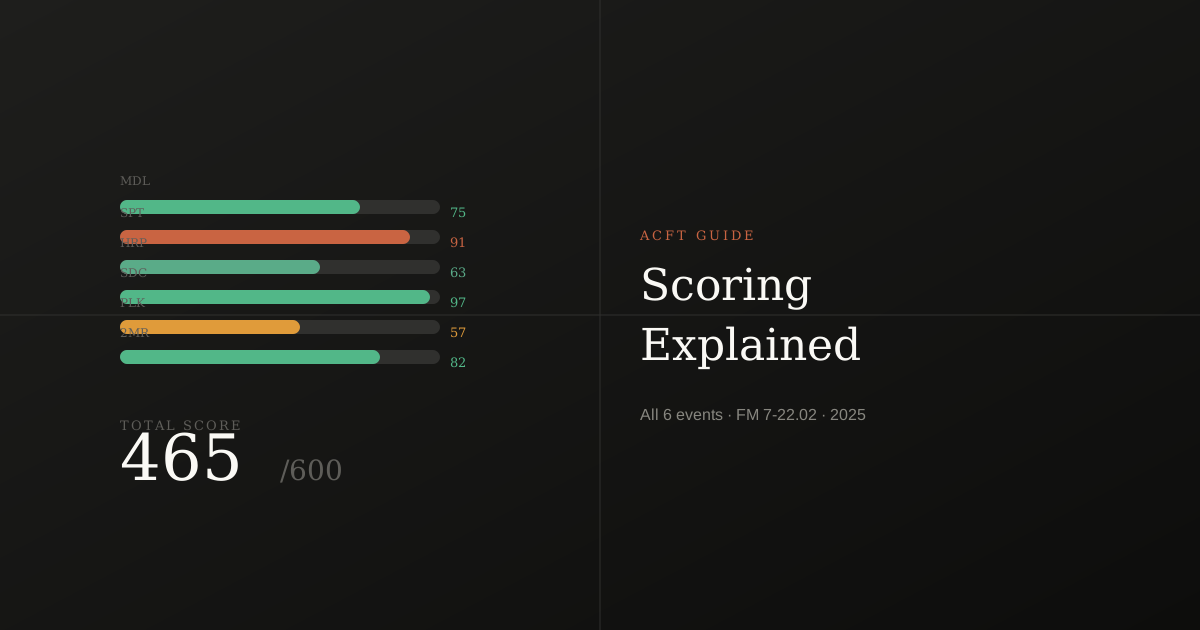
ACFT Scoring Guide: How the Army Fitness Test is Scored
Complete breakdown of all 6 ACFT events: scoring tables, pass/fail criteria, linear interpolation, a…
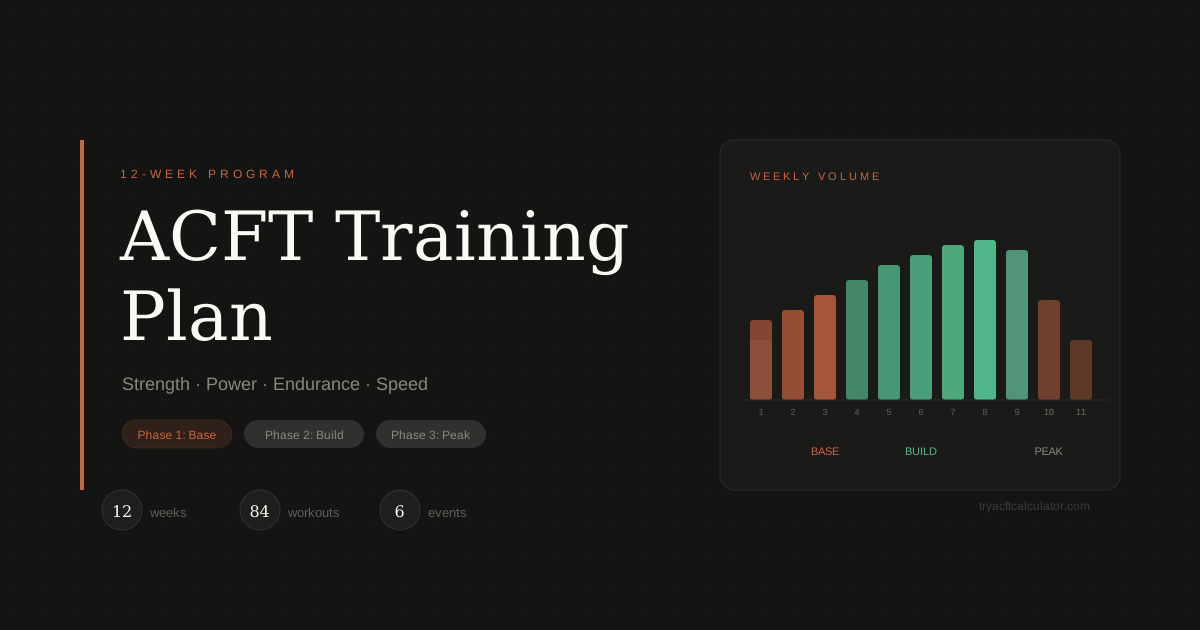
12-Week ACFT Training Plan to Max Your Score
Week-by-week ACFT training plan with periodization, event-specific programming, assessment week, nut…
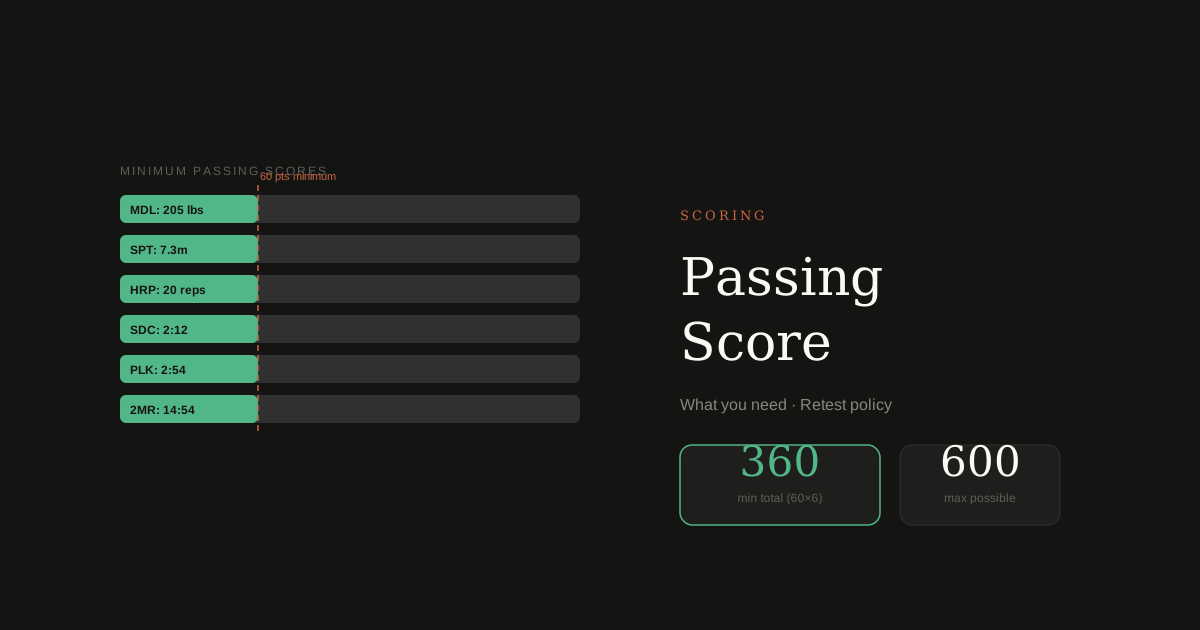
ACFT Passing Score: Minimums, Requirements & Retest Policy
Everything you need to know about ACFT minimum scores, per-event passing thresholds, what a perfect …